


1
Answer the 20 RBQ-2A questions
Choose the response that best describes your usual experience. Each item has three options, worded for its topic: frequency, intensity, impact, change, or preferred activity.
Take the RBQ-2A online to reflect on repetitive movements, focused interests, routines, and responses to change. Get your mean score instantly, with a clear, non-diagnostic explanation.
This page uses the 2015 adult RBQ-2A questionnaire. It is a self-report research measure, not a diagnostic test, and the original study did not establish a clinical cutoff.
Choose the option that best describes your usual experience. There is no right or wrong response.
Your answers and free score stay in this browser tab. They are sent and stored only if you explicitly choose the paid report and consent to report delivery.
A 20-item adult self-report questionnaire developed for research into restricted and repetitive behaviours.
The RBQ-2A asks adults about repeated movements, sensory interests, collecting, routines, sameness, and preferred activities. It was adapted from the RBQ-2 for adult self-report and published in 2015.
20 questionsAbout 4 minInstant mean score
Complete the questionnaire privately in your browser. No account is required, and all 20 items must be answered before your score is calculated.
Choose the response that best describes your usual experience. Each item has three options, worded for its topic: frequency, intensity, impact, change, or preferred activity.

Go back to any question whenever an answer needs another look. After the last item, open the review screen to check or change any response before you see your result.

See your mean and raw total immediately. Download a plain-text copy or use your browser’s Print dialog to save the completed RBQ-2A result as a PDF.
The original study looked at how the items group together: repeated movement and sensory behaviours, and insistence on sameness.
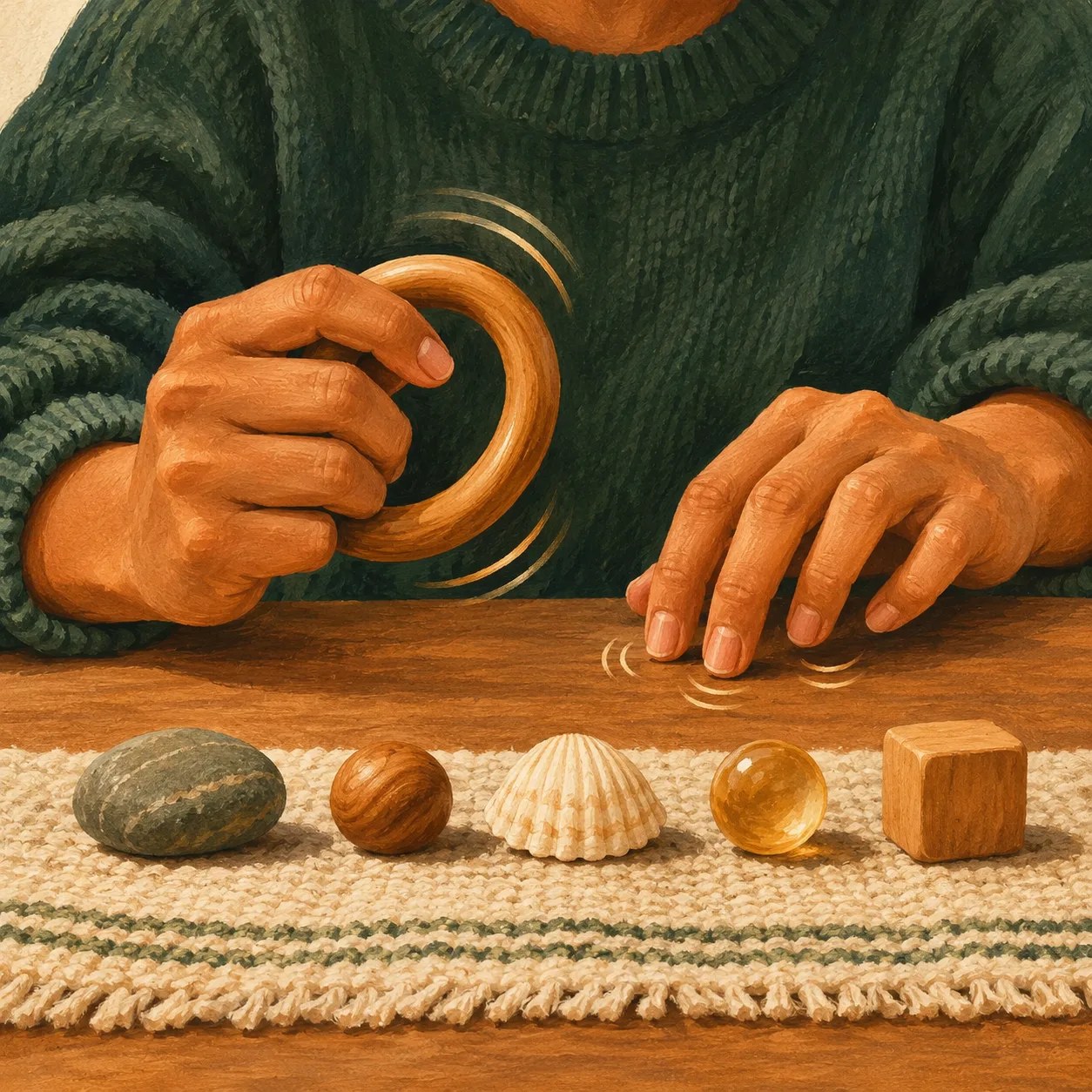
Items include arranging, fiddling, rocking, pacing, repeated hand movements, unusual viewing angles, smells, and textures.

Items include routines, object placement, doing things until they feel right, repeated media, clothing, foods, and preferred activities.
Think about what usually happens across settings rather than one unusual day.

You may spend long periods on one topic, collection, object, texture, or sensory detail.
A familiar sequence, place, meal, or item may feel easier, while an unplanned change may require adjustment.
Movement, arranging, fiddling, or repeating an activity can be noticeable, subtle, enjoyable, regulating, or context-dependent.
Your result shows one mean from all 20 responses, plus your raw total and every answer you gave.
This example is not a benchmark or cutoff.
Start the RBQ-2A Test NowScoring is simple, but interpretation needs care.
The first option scores 1, the middle option scores 2, and the final option scores 3. Wording changes between question groups, but the numeric direction stays the same.
Add the item scores to get a raw total from 20 to 60, then divide by 20. The mean therefore ranges from 1.00 to 3.00.
The original paper reported group averages for research, not a score that diagnoses an individual. Do not treat group means as personal cutoffs.
This page names the exact version so the result is not confused with later questionnaires.
The items are reproduced with light punctuation and accessibility edits from Barrett et al. (2015), The Adult Repetitive Behaviours Questionnaire-2 (RBQ-2A), Journal of Autism and Developmental Disorders, doi:10.1007/s10803-015-2514-6. The article is licensed under Creative Commons Attribution 4.0 International (creativecommons.org/licenses/by/4.0/). Changes are indicated here. RBQ-3 is a later measure and is not presented as RBQ-2A on this page.
English is the source questionnaire. Localized wording on this page is provided for accessibility and is not presented as a validated RBQ-2A translation. Use an authorized validated version for research or clinical administration.

A score is more useful when you connect it to context, comfort, and daily life.
Keep exploring
Choose another questionnaire to explore a different part of your experience.

Answer 18 questions on attention, hyperactivity and impulsivity. Get original and 2024 Part A scores.

Explore a broader set of adult autistic traits across several domains.

Compare a different research questionnaire covering five trait areas.
Reflect on social camouflaging and the effort behind outward behaviour.
Clear answers about scoring, meaning, privacy, and versions.
The RBQ-2A, or Adult Repetitive Behaviours Questionnaire-2, is a 20-item self-report questionnaire for adults. It asks about repetitive movements, focused interests, routines, sameness, and responses to change. Researchers published it in 2015 as a descriptive research tool, not a diagnostic test.
Each of the 20 answers scores 1, 2, or 3. Add all item scores for a raw total between 20 and 60, then divide by 20 for a mean between 1.00 and 3.00. The page calculates both values as soon as you finish.
A higher mean means you endorsed the listed behaviours more often or more strongly across the 20 items. The 2015 study did not set a clinical cutoff, so no score can label a person as autistic or non-autistic. Use the result as a starting point for reflection, not as a verdict.
The RBQ-2A was studied with adults aged 18 to 50, and its authors warned that the findings may not generalize to older adults. This page presents it as an adult self-report measure rather than a questionnaire with a universally validated age range.
The RBQ-2A cannot confirm or rule out autism on its own, regardless of whether the score is high or low. It is a descriptive self-report research questionnaire. A proper autism evaluation also considers developmental history, daily impact, other possible explanations, and clinical judgment from a qualified professional.
The RBQ-3 is the later measure. Cardiff University describes it as replacing the RBQ-2 and RBQ-2A for later research use. This page presents the published 2015 RBQ-2A as the older adult measure, and the two questionnaires should not be treated as interchangeable.
Select Print after you finish, then choose Save as PDF in your browser's print dialog. You can also download a plain-text file with your mean, raw total, and responses. The page offers no blank questionnaire PDF, and completed free answers are not uploaded.
Answers from the free questionnaire stay in your current browser tab and are not uploaded. If you choose the paid report and give consent, your 20 answers are stored securely and sent to the configured AI provider, which creates and delivers your private report.

Answer at your own pace and keep the result as a starting point for reflection.