
Can ADHD, Anxiety, OCD, Trauma, or Burnout Affect RAADS-R Results?
A RAADS-R result is one self-report snapshot. ADHD, anxiety, OCD, trauma-related experiences, and burnout may overlap with some answers, but the total cannot identify which condition caused them.

The short answer
Treat the result as a snapshot, not a condition detector
RAADS-R is an 80-item adult self-report measure organized into four domains. The original study described it as a clinician-supported aid to diagnosis, not a standalone diagnosis. A total compresses many answers into one number. It does not preserve when an experience began, where it happens, what triggers it, how it changes with stress, or which explanations may coexist.
The most useful next step is not to calculate a correction for anxiety, ADHD, or burnout. Preserve the domain pattern and add a timeline: lifelong examples, recent changes, settings, exceptions, demands, recovery, and functional effects. A broader assessment can then compare information that the total cannot contain.
Keep with the score
- • Domain pattern and original responses
- • First remembered examples and later changes
- • Settings, triggers, exceptions, and recovery
- • Existing diagnoses, health changes, and support needs
Do not infer from the score
- • Which condition caused an answer
- • A personal probability or severity level
- • That one diagnosis excludes another
- • A condition-specific score correction
Evidence context
What a RAADS-R result can and cannot tell you
RAADS-R may add one self-report perspective to an adult autism assessment. It cannot confirm autism, rule out coexisting conditions, diagnose ADHD or OCD, or rate the severity of a person's difficulties. The complete RAADS-R guide explains how the four domains fit together.
The original case-control validation selected 65 as the threshold that best separated 201 autistic and 578 comparison participants. Sensitivity was 97% and specificity was 100% in that study design. Those numbers do not give an individual person's probability of being autistic.
In a later NHS specialist referral sample of 50 adults, RAADS-R totals were not associated with the eventual diagnostic outcome. These results can coexist because the participants, referral pathways, and reference procedures differed.
| Study setting | Participants | Reported result | What it can support |
|---|---|---|---|
| Original case-control validation | 779 people, including 201 autistic participants | 97% sensitivity and 100% specificity | Separation within that selected study design |
| NHS specialist referral service | 50 adults already referred for assessment | Total was not associated with diagnostic outcome | A total may not sort people in a referred clinical population |
Overlapping answers
Why different experiences can look similar on a questionnaire
A self-report response records how a person interprets an experience, not the cause of that experience. Withdrawal, repetition, concentration difficulty, exhaustion, or a need for predictability can occur through different processes. The useful distinction is between what happened outwardly, what was happening internally, and whether the pattern is lifelong, recent, episodic, or mixed.
| Observable experience | Possible reasons | Context that adds information | The answer cannot establish |
|---|---|---|---|
| Withdrawing socially | Overload, fear, trauma-linked safety responses, low capacity, or several processes | First remembered period, triggers, easier settings, and recovery | Which reason caused the response |
| Repetition or ordering | Habit, distress reduction, routine preference, intrusive thoughts, or mixed reasons | Preceding thought, function, relief, distress, and whether the action feels unwanted | An OCD or autism conclusion |
| Difficulty concentrating | Worry, poor sleep, fatigue, demand load, attention differences, or mixed factors | Recent strain, childhood history, settings, and functional impact | That current state changed the total by a known amount |
Self-report also depends on how a person reads each question, memory, language, response style, and masking. These are prompts for clarification, not reasons to add or subtract points.
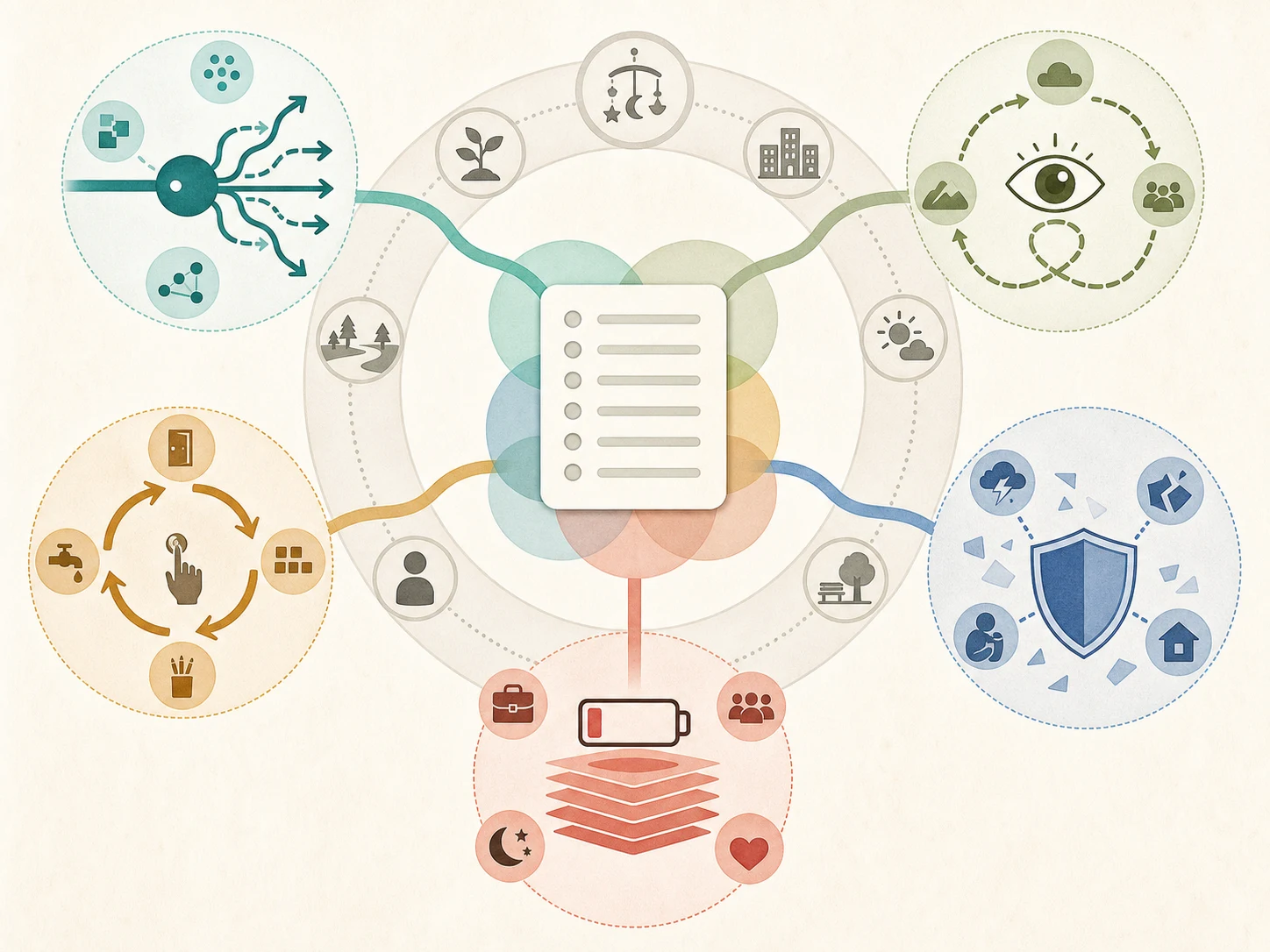
Five contexts
ADHD, anxiety, OCD, trauma, and burnout in context
The comparison below is not an online differential diagnosis. It shows which additional questions make an overlapping answer more informative while leaving coexistence open.
| Context | Possible overlap | Context worth recording | RAADS-R cannot decide |
|---|---|---|---|
| ADHD | Attention, organization, restlessness, or social demands | Childhood onset, persistence across settings, and what helps | Whether ADHD explains an answer or autism is also present |
| Anxiety | Avoidance, fatigue, poor sleep, or concentration difficulty | Fear-based worry and changes with stress or time | Whether fear is the source of an answer |
| OCD | Repetition, checking, ordering, or distress | Intrusive thoughts, the function of a behavior, relief, and impairment | Why the behavior occurs or whether OCD is present |
| Trauma-related responses | Avoidance, arousal, sleep difficulty, or detachment | Timing after trauma, triggers, changes in felt safety, and recovery | Whether trauma explains the result |
| Autistic burnout | Exhaustion and reduced capacity | Change from personal baseline, accumulated demands, and recovery needs | Whether burnout is present or caused the score |
ADHD and executive or social demands
Adult ADHD can involve attention and organization difficulties, impulsivity, or restlessness that affect daily functioning and begin in childhood. A useful history asks when those pressures first appeared, where they occur, and what changes them. RAADS-R cannot diagnose ADHD or decide whether autism coexists.
If you are exploring how co-occurring autistic and ADHD traits may be concealed or compensated for, the AuDHD masking guide focuses on that question; a RAADS-R score cannot settle it.
Anxiety and fear-driven avoidance
Anxiety may involve difficult-to-control worry, irritability, fatigue, tension, sleep disruption, and concentration problems. Fear-driven avoidance during a stressful period is worth recording beside longer patterns. It is not evidence that anxiety explains every endorsed answer.
OCD and intrusive-thought-driven behavior
OCD involves recurring intrusive obsessions, compulsions, or both, with distress or functional interference. A repeated action alone does not reveal its function. Record preceding thoughts, whether the action feels unwanted, the relief it brings, and its practical impact.
Trauma-related responses and safety learning
Trauma-related responses may include avoidance, heightened arousal, sleep and concentration difficulty, negative mood or cognition, and detachment after trauma. Timing, triggers, and changes in felt safety add context. No evidence supports calculating a trauma adjustment for a RAADS-R score.
Burnout, exhaustion, and recent capacity change
Autistic burnout is a developing research construct commonly described through exhaustion, reduced access to functioning, and lower tolerance for input. A 2025 review covered 48 studies and about 4,000 autistic people, while definitions and measurement methods varied. RAADS-R does not measure burnout, depression, crisis risk, or recovery.
Interpretation limit
A high score does not identify its cause
A total may support the decision to look more closely, but it cannot say why it is high. Turning a score into a causal label creates more certainty than the instrument contains.
The phrase false positive can also mislead. In screening research, it describes a positive classification that does not align with a reference diagnostic outcome. It does not mean the person fabricated their experience, and it does not name the reason for the mismatch.
Questions a high result can prompt
- • Which domains and individual answers stood out?
- • Which experiences have been present across development?
- • What changed recently or varies by setting?
- • Would professional clarification serve a practical goal?
Questions the total cannot answer
- • Which diagnosis caused the number?
- • How much anxiety or ADHD added to it?
- • Whether one condition replaces another
- • Whether retesting reveals the true score
Retaking the questionnaire after a difficult day may produce a different self-report, but it still does not perform differential diagnosis. Repeated testing can also change memory and interpretation of the questions. Preserve the original result and record what was happening when you completed it. The high-score next-step guide provides a practical sequence.
Timeline
Separate lifelong patterns from current-state change
Adult recognition can occur much later than developmental onset. A timeline does not decide a diagnosis. It helps separate stable experience from changes linked with episodes, settings, illness, stress, or demand without inventing a score-correction rule.
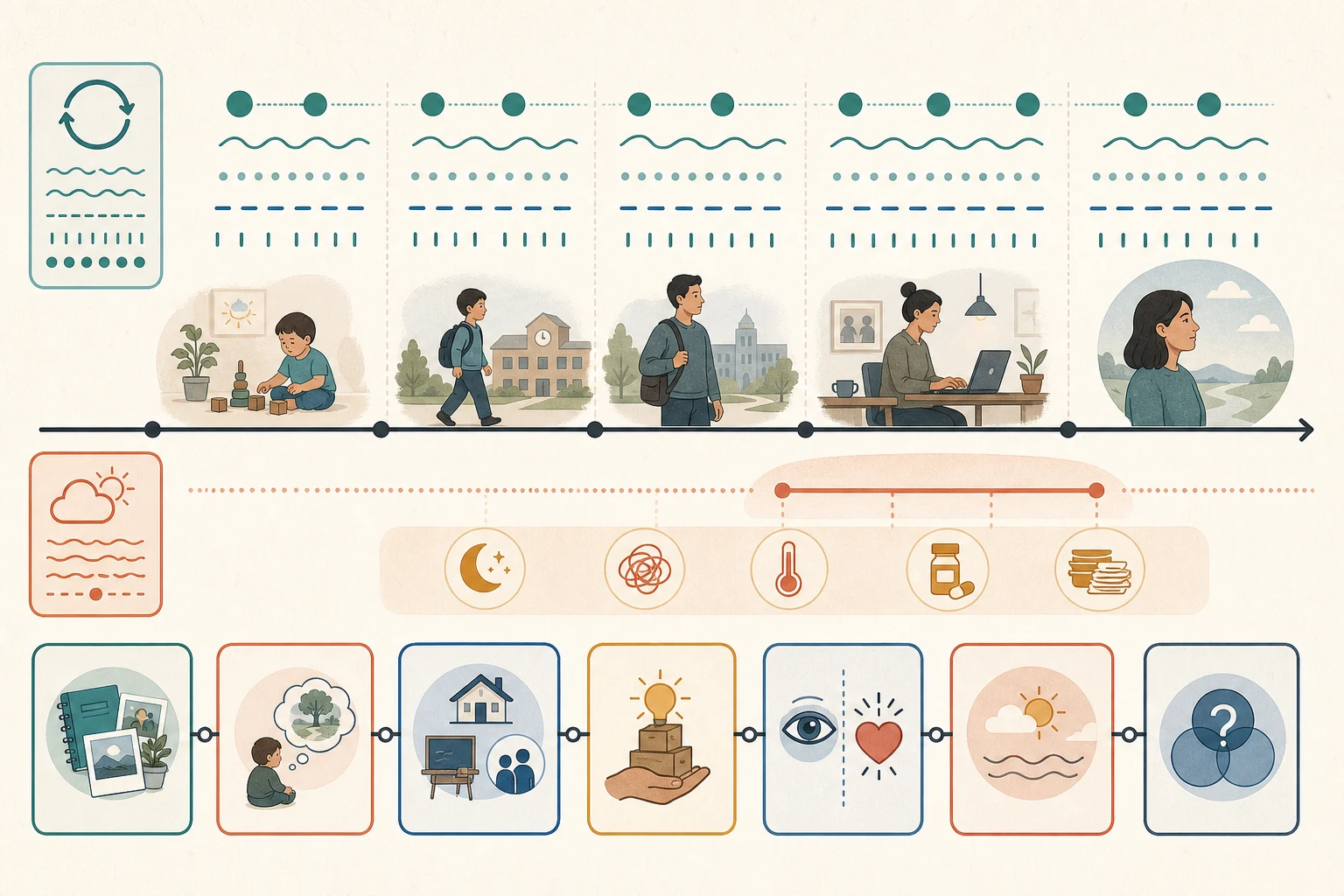
| Pattern | Timing evidence | Settings and recovery | Functional effect |
|---|---|---|---|
| Lifelong | Childhood records, family account, or personal memory when available | Across settings, with exceptions and recovery noted | Longstanding supports and daily-task effects |
| Recent or episodic | Later change after an earlier baseline | Episodes, triggers, health changes, and recovery | New support needs or functional change |
| Context-specific | Clusters around one setting or demand | Compare people, expectations, structure, and sensory load | Effect of accommodations on participation |
| Mixed | Longstanding pattern plus later capacity change | Separate baseline from newer triggers and recovery | Persistent and new effects recorded separately |
Missing school reports or a childhood informant does not automatically end assessment. NICE guidance asks for early developmental history where possible and also considers current functioning, direct observation, differential diagnoses, and coexisting conditions.
Coexistence
Autism versus another condition is often the wrong frame
ADHD, anxiety, OCD, trauma-related concerns, and autism need not be mutually exclusive. The more useful question is which developmental patterns, present difficulties, strengths, and support needs exist together. The adult autism signs guide explains why connected patterns across time and settings carry more information than one red flag.
Diagnostic clarification and practical support are related but separate decisions. A person can discuss lower sensory load, clearer routines, written communication, or recovery time without treating those needs as proof of any diagnosis.
A practical tool
Use a seven-field context and timeline worksheet
Record one item or experience per row in ordinary language. Keep uncertainty visible. The value lies in the contrasts: what was present early, what varies by setting, and what changed more recently.
| Item or experience | First remembered period | Settings and exceptions | Trigger or demand | Observable and internal effect | Current-state change | Alternative or coexisting explanations |
|---|---|---|---|---|---|---|
| Avoids group conversation | Primary school | Easier one-to-one; harder in unfamiliar groups | Rapid turn-taking and background noise | Becomes quiet, feels tense, loses track, needs recovery | More intense during poor sleep but also present when rested | Social anxiety, trauma-linked safety learning, autistic social differences, or coexistence |
Do not rank the rows or add points. Include supporting and contradictory examples, such as situations where an experience is easier, absent, or different with a trusted person, lower demand, structure, or recovery time.
- Preserve original wording instead of converting an experience into a label.
- Note whether a change was recent, episodic, or tied to a specific demand.
- Add health, sleep, medication, mood, and environmental changes when relevant.
- Bring earlier records or an informant's account if available, and state what is missing.
The worksheet is not a screener or diagnosis. It is a record for reflection or assessment preparation.
Broader assessment
What a professional adult assessment adds
NICE adult autism guidance places RAADS-R among tools that may assist a complex assessment. A qualified process can integrate information a total compresses:
- developmental history and lifelong continuity;
- current functioning at home, in education, at work, and in relationships;
- direct observation and sensory or communication needs;
- existing diagnoses, physical and mental health, and medications;
- records or an informant when available and with consent;
- differential and coexisting conditions without forcing an either-or answer.
Assessment is optional and goal-dependent. Some people seek developmental clarification, documentation for work or education, or support planning. Others may decide that a saved context record and a clinician discussion are enough for now. Access, cost, waiting time, emotional readiness, and local requirements also matter.
Continue reading
Explore related articles for the questions you want to understand next.


Common questions
RAADS-R results and overlapping conditions FAQ
Can ADHD affect a RAADS-R score?
ADHD can overlap with experiences described by some questionnaire items, but evidence does not support saying that ADHD produces a particular RAADS-R total. ADHD and autism can coexist, so timing, settings, and functional impact matter.
Can anxiety cause a high RAADS-R score?
Anxiety can involve concentration difficulty, sleep disruption, fatigue, and avoidance. Those experiences provide context, but a high total cannot tell whether anxiety, autism, both, or another explanation accounts for an answer pattern.
Can you have a high RAADS-R score and not be autistic?
Yes. In one 2021 sample of 50 adults referred to an NHS specialist service, totals did not predict the eventual clinical diagnostic outcome. A high score can support further reflection, but it cannot establish an individual diagnosis.
Does the RAADS-R diagnose ADHD or AuDHD?
No. RAADS-R does not diagnose ADHD or autism by itself. AuDHD is informal community shorthand for co-occurring autism and ADHD, not a standalone DSM-5-TR or ICD-11 diagnosis.
What can cause a false positive on the RAADS-R?
False positive describes a positive classification that later does not align with a reference diagnostic outcome. A RAADS-R total cannot name the reason for that mismatch or distinguish overlap, coexistence, context, and assessment limits.
The bottom line
Keep the timeline and context, not a search for one definitive number
ADHD, anxiety, OCD, trauma-related experiences, and burnout may overlap with some RAADS-R answers. The total cannot identify their cause or complete a differential assessment. Similar answers may arise around autism, another condition, or more than one process at once.
Preserve the original result and add timing, settings, recent changes, exceptions, demands, recovery, and functional effects. In the 2021 NHS referral study, totals did not predict the eventual diagnostic outcome. That finding does not make the reported experiences meaningless; it shows why a single total cannot sort them into one explanation.
This article provides educational information, not medical advice, diagnosis, or individualized treatment.
Research sources
Official guidance and peer-reviewed evidence
- Ali et al. (2025), systematic review of autistic burnout
- American Psychiatric Association, DSM-5-TR (2022)
- Jones et al. (2021), RAADS-R in an adult NHS referral population
- NHS, obsessive compulsive disorder overview
- NICE, autism spectrum disorder in adults
- NIMH, post-traumatic stress disorder
- NIMH, ADHD in adults
- NIMH, generalized anxiety disorder
- Ritvo et al. (2011), international RAADS-R validation study
- World Health Organization, ICD-11 (2025 release)