
How to Answer RAADS-R Test Questions
RAADS-R questions are easier to approach when you treat them as prompts about timing and lived experience—not as riddles with a hidden correct answer. Use concrete examples, separate current life from experiences before age 16, and choose the closest honest response.

Start here
How should you answer RAADS-R test questions?
This page explains how to answer and interpret the wording. If you came here to see or complete all 80 RAADS-R test questions, open the assessment directly:
The RAADS-R was developed as an adult self-report scale used as one part of clinical assessment. An online version can help you organize observations, but it cannot independently establish a diagnosis or explain why you endorsed an item.
Step 1
Understand the four RAADS-R response options
The four choices describe timing across two periods of life. They are not a scale from “slightly agree” to “strongly agree,” and they do not ask how severe an experience feels.
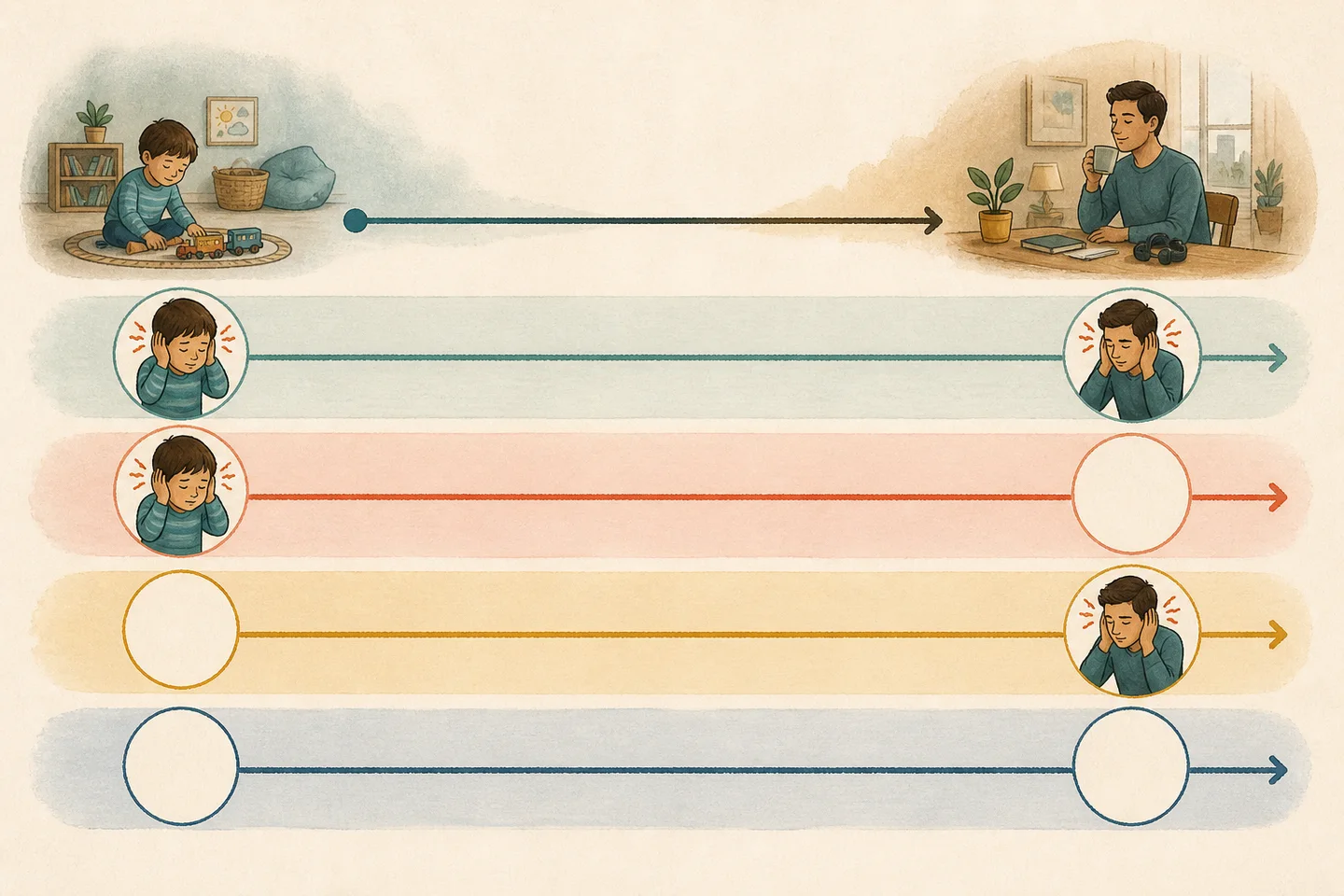
True now and before age 16
The experience fits both current life and your best-supported understanding of childhood or adolescence.
True only now
It fits current life, but you do not recognize it before age 16.
True only before age 16
It fit earlier life, but it does not meaningfully describe you now.
Never true
It does not meaningfully fit either period.
Do not choose an option because it looks as though it awards more or fewer points. The scoring key treats some items differently, but your task is only to describe timing as honestly as you can.
Step 2
Use a five-step process for each question
When wording feels abstract, move from the statement to an actual event before choosing a response.
- 1
Turn the statement into a real example.
Recall a conversation, environment, routine, sensory experience, movement pattern, or interest that matches the wording.
- 2
Read the item literally.
Answer the experience the statement actually describes. Do not guess which autistic trait, domain, or score it may be testing.
- 3
Check current life.
Ask whether this is meaningfully true across your life now, not only during one unusually easy or difficult day.
- 4
Check life before age 16.
Look for recurring early examples. Use your best-supported estimate rather than demanding perfect recall.
- 5
Choose the closest timing option.
Select both periods, now only, before age 16 only, or never. If useful, keep a separate note about uncertainty or context.
One uncertain response will not define the result. A consistent approach across all 80 items is more useful than spending a long time trying to perfect one answer.
Step 3
What if you do not remember life before age 16 clearly?
You do not need a complete autobiography. Childhood recall is often uneven, especially when an experience felt ordinary at the time or when you learned to compensate for it.
Start with the strongest context available:
- recurring memories connected to specific places, people, or routines;
- school reports, journals, photographs, or other records;
- observations from a parent, sibling, friend, or another person who knew you then;
- patterns that became easier to recognize only after comparing childhood and adult life.

Other people's recollections are additional context, not automatically more accurate than your own. If evidence is limited, choose the closest honest response and record the uncertainty rather than inventing a definite childhood history.
Step 4
How to handle vague or ambiguous RAADS-R questions
Some items can feel broad because words such as “often,” “understand,” “comfortable,” or “normal” depend on context. Do not search for a secret clinical interpretation. Use the ordinary meaning of the sentence and anchor it to examples.
Compare more than one setting
Work, home, school, friendships, and unfamiliar places may show whether an experience is broad or tied to one environment.
Separate behavior from effort
A skill may look easy from the outside while requiring scripts, rehearsal, imitation, or recovery. Record that context even when the item asks about visible behavior.
Distinguish a pattern from a recent change
A long-standing experience and a change caused by current stress, illness, burnout, or another event are not the same timeline.
Answer the item, not the diagnosis
Do not ask whether an autistic person would choose an option. Ask whether the described experience fits your own life.
If two interpretations remain equally plausible, note both examples and select the one that best matches the wording. That note may be more useful in a later professional conversation than forcing certainty into one click.
Step 5
Why do some questions feel similar or point in opposite directions?
The 80 items are distributed across four domains: 39 social relatedness, 20 sensory-motor, 14 circumscribed interests, and 7 language items. Related items approach a wider domain from different angles, so some overlap in subject matter is expected.
Social relatedness
Social connection, reciprocity, expectations, and comfort across interpersonal situations.
Sensory-motor
Sensory experiences and movement-related patterns in everyday environments.
Circumscribed interests
Focused interests, routines, attention, and how particular subjects or activities hold attention.
Language
Patterns in conversation and language use, including spoken meaning and conversational flow.
Some statements describe experiences commonly associated with autism, while others describe more typical experiences and are reverse-scored. You do not need to identify or compensate for reverse-scored items. Answer each statement on its own terms; the test handles the scoring direction.
The original international validation study explains the 80-item revision, four domains, and scoring design.
Using this test
Can you skip a question or change an earlier answer?
On this site's assessment:
You can
- • Use Previous to return to an earlier question.
- • Select a different option to replace an earlier answer.
- • Pause to write down an example or uncertainty before continuing.
You cannot
- • Move forward without selecting an answer.
- • Submit the assessment with unanswered items.
- • Ask the total score to explain why you chose an answer.
Selecting an option advances the test. If you notice that a better example changes your interpretation, go back and revise it. Avoid changing answers only because you expect a different option to raise or lower the total.
Common mistakes
Avoid answering for a preferred result
Answering from only the hardest day
An acute crisis can dominate memory. Look for the representative pattern unless the statement specifically describes that change.
Answering as your ideal self
Choose what is meaningfully true, not what you think should be true or how you want others to see you.
Treating timing as severity
The four choices locate an experience across two periods of life; they are not mild-to-severe ratings.
Retaking until scores match
A changing total may reflect new interpretations, not increasing diagnostic certainty. Save context instead of chasing consistency.
The goal is not to produce the highest, lowest, or most convincing score. It is to create a more organized record of how you understood the statements at one point in time.
Interpretation
What your RAADS-R answers can and cannot tell you
Your answers can help
- • Organize experiences across four domains.
- • Compare current and before-age-16 patterns.
- • Identify examples and uncertainties worth discussing.
- • Prepare questions for a professional conversation.
Your answers cannot
- • Confirm or rule out an autism diagnosis.
- • Identify the cause of an endorsed item.
- • Measure a percentage or severity of autism.
- • Replace developmental history and broader assessment.
For how study results change between selected validation groups and real referral clinics, read the
Ready when you are
Answer from experience, not from the score you expect
The assessment contains all 80 items and provides a total plus domain-level results. Save the result together with the date, reason for taking it, difficult items, and any context that shaped your answers.
Continue reading
Explore related articles for the questions you want to understand next.


Common questions
How to answer RAADS-R questions FAQ
Can I skip a RAADS-R question?
This site's test requires an answer before the Next button becomes available. If no option feels exact, choose the closest timing pattern and note your uncertainty separately.
Can I go back and change a RAADS-R answer?
Yes. Use the Previous button to revisit an earlier item and select a different response. Change it because a better example came to mind, not to chase a preferred total.
Do I need perfect childhood memories to answer the RAADS-R?
No. Use your best-supported estimate from recurring memories, school experiences, records, and observations from someone who knew you. Do not invent certainty you do not have.
Should I answer based on my hardest day?
Usually no. Look for a representative pattern across time and settings rather than answering only from an unusually easy or difficult day.
Can the 80 questions diagnose autism?
No. They organize self-reported experiences. The total cannot confirm or exclude autism, identify the cause of an answer, or replace a broader assessment.
Research cited
The explanation of item count, domains, response timing, and questionnaire interpretation draws on the original research. The discussion of ambiguous wording also draws on published work about autistic people's broader experiences with questionnaires and decision-making.