
How to Recover From Autistic Burnout: A Practical Guide
If you are searching for how to recover from autistic burnout, start with the next sustainable action: protect basic needs, lower avoidable load, ask for concrete help, and rebuild selected activities slowly.

Quick start
What to do first when capacity is low
Start by protecting food, fluids, medication, sleep opportunity, communication access, and immediate safety. Reduce avoidable demands and sensory load, ask for concrete help, and reintroduce one activity at a time with recovery space. The capacity states used here are an editorial navigation aid, not validated clinical stages.
Scope and evidence
What this recovery guide can and cannot do
Evidence is still developing. A 2025 systematic review synthesized 48 studies (N = 4,053 autistic participants), finding recurring recovery-related themes such as rest, solitude, sensory relief, self-understanding, and support. The review did not test or establish a universal treatment, validated recovery stages, or a fixed recovery timetable. (Ali et al., 2025) The capacity states used later in the guide are navigation aids, not validated clinical stages, and RAADS-R is kept separate from burnout measurement or recovery tracking.
This guide addresses how to recover from autistic burnout through low-energy options for daily life, work, and caregiving. It is educational, not a diagnosis or treatment plan. For a fuller explanation of symptoms and causes, see what autistic burnout is; this page stays focused on what to do next.
Key takeaways
The recovery sequence at a glance
- Use the lowest-energy safe version of food, fluids, medication routines, communication, and immediate safety before productivity.
- Lower the load itself: defer non-urgent work, reduce decisions and sensory input, simplify communication, and stop turning recovery into another performance target.
- Ask for specific help that removes effort, such as delivering food, handling an errand, canceling a commitment, or sending one clear written update.
- Treat a better hour as information, not a debt to repay; add one activity at a time and leave room to notice delayed effects.
- Recovery has no validated stages or universal timetable. Use capacity and sustainability, rather than speed or your old baseline, as practical signs of direction.
- Seek professional assessment when changes persist, worsen, interfere with basic care, or raise safety concerns; burnout can overlap with depression, illness, pain, sleep problems, or medication effects.
On this page
A low-energy path through the guide
- Abstract
- Key Takeaways
- How to Recover From Autistic Burnout: Start Here
- Protect Basic Needs Before Productivity
- Reduce Demands Instead of Adding More Recovery Tasks
- Make Rest Restorative by Changing the Environment
- Ask for Support That Actually Removes Load
- Return to Activities Gradually Without Spending Tomorrow's Capacity
- How Long Does Autistic Burnout Recovery Take?
- Recover From Autistic Burnout While Working
- Build a Personal Recovery Plan and Know When to Seek Help
- Frequently Asked Questions
- Conclusion
- References
Start here
Begin with current capacity, not your old pace
Community-partnered research describes autistic burnout through exhaustion, reduced access to abilities, and lower tolerance for sensory input. It supports taking a sustained loss of capacity seriously, but it does not validate this page's three capacity labels or turn them into clinical stages. (Raymaker et al., 2020)
Recovery does not mean returning to the old pace
Autistic burnout is commonly described as severe exhaustion with a reduced ability to manage daily life, sensory input, or communication. (Raymaker et al., 2020)
Recovery does not require proving that you can resume every old demand. It means finding a level of activity that does not keep draining tomorrow's capacity.
Three capacity states for navigation, not diagnosis
The site's editors created the three labels below as an editorial framework for reader orientation.
They are not validated clinical stages, a diagnosis, a severity scale, or a way to measure autistic burnout.
| Editorial capacity state | What it means here | Next focus |
|---|---|---|
| Dropping | Capacity is still shrinking; basics or safety are becoming harder | Remove load and secure help |
| Stable | Capacity is limited but is not worsening | Hold demands steady and protect recovery space |
| Rebuilding | Selected activities remain manageable afterward | Add one small activity, then check the later effect |
Choose the next sustainable action
Important: Use the state that best matches today, not the state you think you should have reached. These labels do not determine diagnosis or prove progress.
If capacity is dropping, cancel one demand or ask one person to take a task. If it is stable, preserve what is working rather than catching up. If it is rebuilding, add only one activity and leave recovery space afterward. When deciding how to recover from autistic burnout, judge the action by what it costs afterward, not by how productive it feels today. The trade-off is that doing less today may preserve more usable capacity tomorrow. If tomorrow is harder, make the step smaller. The goal is a repeatable day, not one productive hour followed by deeper depletion.
Step 1
Protect basic needs before productivity
If you are deciding how to recover from autistic burnout today, put productivity aside. Aim for a workable floor: food, fluids, medication handled safely, a tolerable place to rest, and a way to signal for help. The smallest version counts.
Food and fluids when preparation is hard
Remove preparation and choice. Use familiar foods you can open and eat. Keep a drink within reach. If swallowing, nausea, allergies, diabetes, or another health need limits what is safe, follow existing medical guidance or ask a clinician.
- Pick one food that needs no cooking.
- Put a bottle, cup, or straw beside your resting place.
- Ask someone to deliver a specific item rather than asking for general help.
Medication, hygiene, shelter, and caregiving
Protect the routine without demanding its ideal form. Use reminders or an organizer only if already part of a safe system. For hygiene, change clothes, wash one area, or brush your teeth while seated. A text such as "Please feed the cat today" can transfer caregiving without a conversation.
If housing, heat, electricity, caregiving, or physical safety is at risk, contact a trusted person or a service now.
Important: Do not change a medication dose or schedule because the routine feels impossible. If you missed a dose or cannot remember whether you took it, ask a pharmacist or prescriber what to do. (MedlinePlus, 2024)
A lowest-energy version of each task
For each necessary task, name the minimum safe result, then stop. Prepared food can replace cooking. A text can replace a call. Moving supplies beside the bed can replace repeated trips. Learning how to recover from autistic burnout starts with preserving capacity, not proving it.
Research associates recovery with conditions such as rest, sensory relief, self-understanding, and support, but it does not establish one universally effective treatment. (Ali et al., 2025) Protecting basic needs is therefore a practical safety floor, not proof that a particular strategy treats autistic burnout.
Step 2
Reduce demands instead of adding recovery tasks
Community-partnered research reported time off and reduced expectations in participants' autistic burnout recovery accounts. (Raymaker et al., 2020) The four buckets below translate that broad theme into an editorial planning aid. They are not a validated recovery protocol, and the useful outcome is less load rather than a perfectly completed worksheet.
Learning how to recover from autistic burnout can become another demand: meals to optimize, symptoms to log, exercises to finish, and advice to process. If recovery brings pressure or guilt, reduce the recovery plan too.
Sort work with four demand buckets
| Category | Test | Example | What to do |
|---|---|---|---|
| Must | Will harm follow if it waits? | Medication or immediate safety | Do the lowest-energy version |
| Defer | Can it wait safely? | Laundry or a nonurgent reply | Set a review date |
| Delegate | Can someone else own it? | Groceries or rescheduling | Transfer the task and follow-up |
| Drop | Is it optional or mainly expected? | Extra hosting or voluntary admin | Remove it without replacement |
The aim is fewer items. Delegating can still cost energy when you must explain, remind, and check, so ask whether someone can take full ownership.
Reduce decisions and simultaneous demands
Try the checklist for a few days:
- Pick a default meal, outfit, or route when choice is tiring.
- Silence optional notifications and pause nonurgent message threads.
- Finish or stop one task before opening another.
- Ask people to send one clear request at a time.
These are experiments, not rules. Keep only the changes that lower effort in practice.
Keep the true must-do list narrow
A must-do list should protect health and safety, shelter or dependents, plus time-bound obligations. Everything else deserves another pass through the table. Even helpful practices such as journaling, meditation, exercise, or researching burnout can be deferred or dropped when they feel like assignments.
When capacity shifts, sort again. Moving a task between columns is not failure. Ask, "What can stop requiring energy now?"
Step 3
Make rest more restorative by changing the environment
Recent qualitative research describes sensory and social rest as adaptive needs reported by autistic adults during burnout. (Ali et al., 2026) Rest may therefore feel more restorative when it lowers what a person must keep processing, not merely when paid work stops. That observation guides experimentation; it does not establish a treatment response.
Why time off may not lower the load
A day away from work can still contain noise, household decisions, incoming messages or conversation, plus pressure to be available. Those demands may leave little room for recovery.
When asking how to recover from autistic burnout, check what your environment still requires you to notice, decide, explain, or tolerate.
Adjust sensory input and communication around social access
Recent qualitative research describes sensory and social rest as adaptive needs reported by autistic adults during burnout. (Ali et al., 2026) Try one or two changes, then keep only those that feel lower-load:
- Dim lights, close a curtain, use familiar clothing, or move somewhere quieter.
- Silence nonurgent alerts and check messages at one chosen time.
- Ask for written communication, shorter messages, fewer choices, or use a prepared reply.
- Choose quiet company, delayed replies, no conversation, or privacy.
Lower social load does not have to mean total isolation. Quiet company may suit one person; privacy may suit another. Keep only changes that reduce sensory, communication, or social effort for you.
Use familiar interests only when they restore capacity
Official autism guidance lists re-energising interests as one possible way to recover energy. (National Autistic Society, 2020) It is an individual option, not therapy. The same activity can settle one person and tax another.
Choose the version with the lowest entry cost. Listening may work when researching does not; sorting may work when creating does not. If the activity brings goals, social obligations, or pressure to finish, pause it. When considering how to recover from autistic burnout, restorative rest is the environment and activity combination that asks less of you afterward.
The separate autistic fatigue guide explains why more sleep or time off may still leave sensory, social, decision, masking, or health-related load in place.
Step 4
Ask for support that actually removes load
Research identifies individual and community support among reported protective or recovery-related factors. (Ali et al., 2025) The practical test is whether help removes a decision, errand, message, or demand while preserving consent. Advice that creates explanation, monitoring, or gratitude work may add load instead.
Turn vague offers into one concrete request
Learning how to recover from autistic burnout can include asking someone to own one task, not asking them to solve everything. Make the request small enough to answer with yes or no. Include the task, timing, acceptable choices, and how much contact you want.
- "Could you order my usual dinner and leave it at the door by 6? Text once; I may not reply."
- "Can you collect my prescription? Ask me only if the pharmacy offers a substitution."
- "Could you cancel Saturday for me and say only that I am unavailable?"
If forming a request is too hard, send a saved message such as: "I have very little capacity. Please offer one specific thing you can take over."
What supporters can do
- Offer one or two bounded options, with "neither" as a valid answer.
- Own the whole task, including planning, messages, travel, and follow-up.
- Use the person's preferred communication method and make replies optional.
- Keep arrangements predictable, then confirm any change before acting.
Note: Consent is part of support. Ask before entering someone's space, touching them, changing sensory conditions, speaking for them, or contacting another person on their behalf. A low-energy "no" needs no defense.
What supporters should avoid
- Do not arrive unannounced or make a decision without permission.
- Do not ask broad questions, send repeated check-ins, or turn help into a conversation.
- Do not prescribe a recovery plan, push social contact, or praise productivity.
- Do not expect gratitude, updates, or proof that the help worked.
Use one test: did the action remove a decision, errand, message, or demand without taking control away?
Step 5
Return gradually without spending tomorrow's capacity
Current evidence describes recovery-related conditions but does not validate a universal pacing or re-entry protocol. (Ali et al., 2025) The method below is an editorial experiment: change one activity, protect recovery space, and observe delayed effects. It should not be used to diagnose burnout or score recovery.
Choose one small re-entry experiment
Pick one low-stakes activity, such as replying to a message or taking a familiar walk. Test only that activity, not a whole routine. The goal is to learn what your capacity can hold without turning a moment into catch-up.
- Choose the smallest useful version.
- Decide the stopping point before you begin.
- Keep optional tasks out of the same activity block.
- Note what happens afterward, not only how the activity feels during it.
Leave recovery space around the activity
Keep the time before and after light. Prepare any food, fluids, medication, sensory aids, and quiet space you need, then avoid placing the experiment between other demands. Check again later that day and the following day, rather than assuming the activity was sustainable because it felt manageable while you were doing it.
Count those delayed effects when deciding how to recover from autistic burnout. If basic care or later capacity drops, shrink the activity, add recovery space, or postpone repeating it.
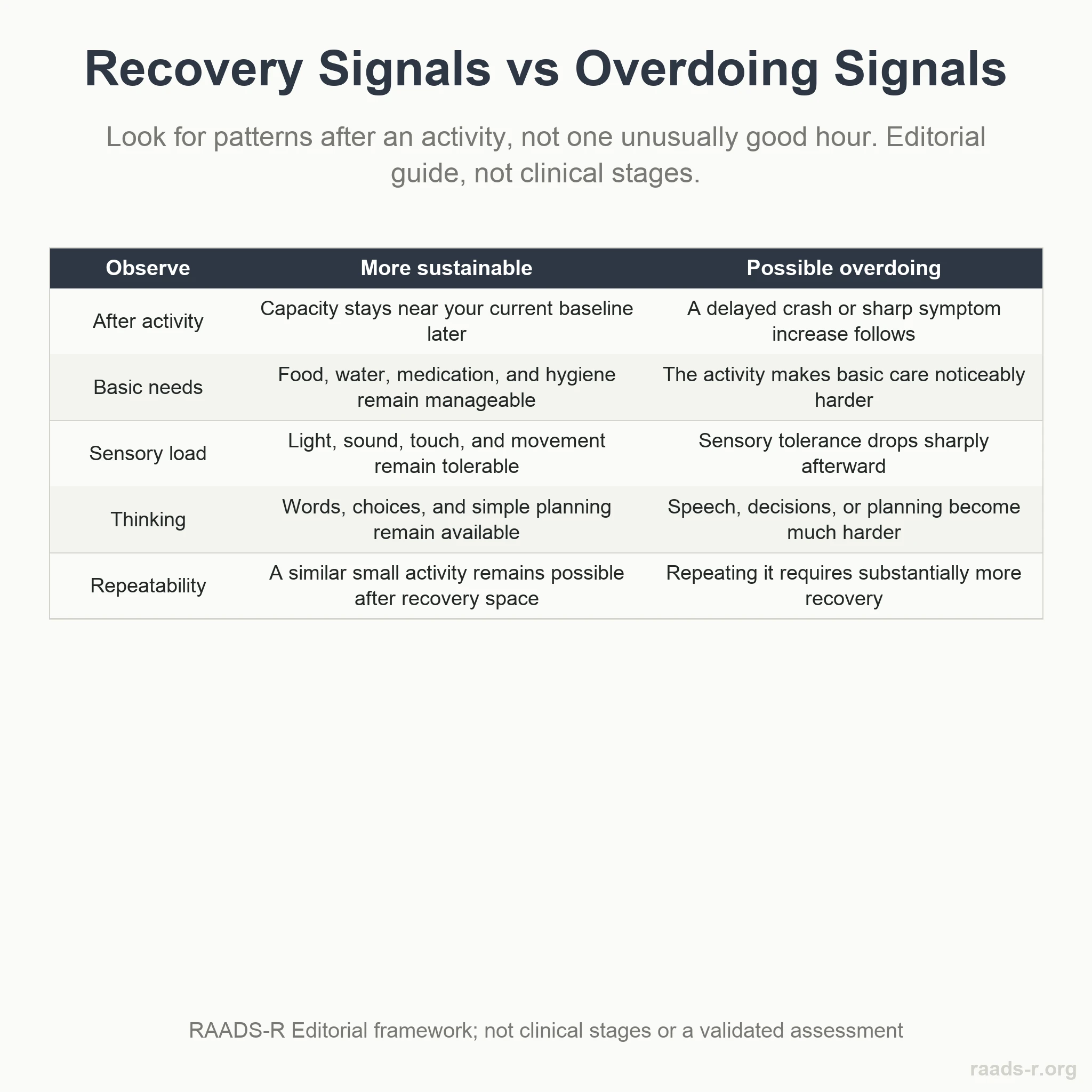
Signs of recovery versus signs of overdoing
Use the table as an observation aid, not clinical criteria, diagnosis, stages, or a score. Compare the activity with your current baseline after delayed effects are included.
If you have also completed RAADS-R, see What to Do After a High RAADS-R Score: 7 Practical Next Steps.
| Observe | More sustainable | Possible overdoing |
|---|---|---|
| Later capacity | Capacity stays near the current baseline. | A delayed crash or marked difficulty follows. |
| Basic needs | Food and fluids, plus medication and hygiene, remain manageable. | The activity makes basic care harder. |
| Sensory and thinking load | Sensory tolerance, words and simple choices remain available. | Sensory tolerance, speech, or planning becomes much harder. |
| Repeatability | A similar small activity fits after recovery space. | Repeating it demands substantially more recovery. |
When judging how to recover from autistic burnout, favor repeatable access over a single unusually productive hour. Unexpectedly, a better hour can be a reason to protect the buffer rather than catch up. A smaller activity that leaves tomorrow usable is more informative than a larger effort followed by lost capacity.
Timeline
How long can autistic burnout recovery take?
A 2025 systematic review covering 48 studies (N = 4,053 autistic participants) found that autistic burnout duration varies; it did not establish a reliable typical recovery time, a minimum duration, or fixed clinical recovery stages. (Ali et al., 2025) The evidence supports an uncertain, person-specific course, not a countdown for one person's recovery. (Ali et al., 2025)
Why there is no reliable typical timeline
Current evidence includes substantial qualitative work, while epidemiology and formal guidance remain underdeveloped. (Jahandideh et al., 2025)
Week or month estimates look more precise than the evidence allows. (Ali et al., 2025) Demands, rest, sensory conditions, and support differ, so people's recovery paths may not be comparable. (Ali et al., 2025)
Important: Do not turn another person's recovery duration into your deadline. When deciding how to recover from autistic burnout, plan around today's usable capacity, not a named week or month.
Measure access and sustainability, not speed
Define progress as a sustainable change in access and capacity. Ask whether food, medication, communication, sensory tolerance, or a small activity remains more available without a later loss of function.
Research describes reduced abilities and increased sensory or social difficulty, while rest, sensory relief, and support appear as recovery-related themes. (Ali et al., 2025)
When judging how to recover from autistic burnout, favor changes that repeat at a sustainable cost.
At review, ask what has become easier to access and keep doing, not whether recovery is "on schedule."
Work
How to recover from autistic burnout while working
If complete leave is impossible, make work smaller and quieter. Workplace adjustments may address job demands, but no adjustment guarantees treatment or recovery from autistic burnout. (Petty et al., 2023) Start with one load and one change.
Reduce the job before reducing yourself
Do not make greater masking or longer hours the first response. Name the job demand consuming capacity, then ask whether it can be removed, reduced, moved, or made predictable. Aim for a sustainable job shape, not better performance at hiding strain.
Workplace-adjustment research identifies flexible hours, clear instructions, and lower-stimulus environments as practical categories for autistic employees. The evidence describes accommodations rather than testing autistic burnout treatment, so none is a guaranteed recovery method or a substitute for an individualized discussion. (Petty et al., 2023)
Examples of workplace adjustments
Use the table as a discussion menu, then check employer policies and applicable rules.
| Workplace load | Adjustment category to discuss | Possible change |
|---|---|---|
| Difficult start times | Flexible hours or a stable adjusted schedule (Petty et al., 2023) | More recovery space around work |
| Ambiguous tasks | Clear written instructions with priorities and deadlines (Petty et al., 2023) | Fewer next-step decisions |
| Noise, light, or interruptions | A lower-stimulus space or remote work where feasible (Petty et al., 2023) | Lower sensory exposure |
| Meetings or rapid verbal exchange | Fewer meetings, agendas, written communication, and reply time | Less real-time communication |
Plan the transition into and out of work
Count getting ready and commuting, plus decompression, as part of the day's load.
- Before work, prepare food, medication, clothing, transport, sensory aids to reduce morning decisions.
- Leave a quiet buffer before the first task; skip optional errands on the way in.
- After work, protect a low-demand period before messages, chores, or caregiving when possible.
- Check whether basic needs and some next-day capacity remain. If not, discuss another change.
When deciding how to recover from autistic burnout while working, judge an adjustment by the load it removes. Revise a poor fit without treating it as personal failure.
Your plan
Build a personal recovery plan and know when to seek help
When deciding how to recover from autistic burnout, use one page to turn capacity into choices. Record what changed, what must continue or stop, and who needs to know. It is a snapshot, not a clinical stage.
A one-page recovery plan
| Plan field | Compare or record | Example |
|---|---|---|
| Baseline change | Usual capacity versus now | "Speech drops; cooking is too hard." |
| Current necessities | Food, fluids, medication, sleep opportunity, shelter, caregiving | "Keep food visible; set medication reminders." |
| Demands | Must, defer, delegate, or drop | "Pay rent; pause appointments; request grocery help." |
| Sensory and communication changes | Inputs and channels that lower load | "Dim lights; use text; decline calls." |
| Support request | Person, task, clear limit | "Sam handles school pickup through Friday." |
| Next small experiment | One reversible activity, then recovery space | "Try a brief walk; keep the evening open." |
| After-effects and review date | Later effects and reassessment date | "Note next-day effects; review Friday." |
| Safety boundary | Trigger for professional or crisis help | "Needs are unmanageable, mood worsens, or I cannot stay safe." |
Research describes varied recovery-related supports rather than one universal treatment or timetable. (Ali et al., 2025) A one-page plan can connect those broad themes to current needs, but it remains an editorial tool. Revise it when capacity, responsibilities, support, health, or safety changes.
If you are not improving, review other explanations
Slow or absent improvement warrants a wider review. Ask a clinician about depression or sleep problems and pain. Medication effects or changes may matter too, as can infection or another illness. Problems may overlap. (MedlinePlus, 2025) For more detail, see autistic burnout vs. depression.
Professional and urgent support
Seek professional help if fatigue or loss of function persists, worsens, interferes with basic care, or is accompanied by new or medically concerning symptoms. (MedlinePlus, 2025) Knowing how to recover from autistic burnout should never require waiting through danger.
Warning: In the United States, call or text 988 for suicidal thoughts or a mental health crisis. Call 911 for immediate danger or a medical emergency. In other countries, use the local crisis line or emergency service. (SAMHSA, 2025)
Continue reading
Explore related articles for the questions you want to understand next.


Common questions
Autistic burnout recovery FAQ
How do you recover from autistic burnout?
If you are asking how to recover from autistic burnout, begin with basic needs, remove avoidable demands, lower sensory and communication load, ask for concrete help, and reintroduce activities gradually. These are practical supports to adapt, not a validated treatment sequence.
How long does autistic burnout last?
Evidence gives no typical duration or minimum. When deciding how to recover from autistic burnout, use present capacity rather than another person's deadline; autistic burnout can last for different lengths of time.
How long does it take to recover from autistic burnout?
Recovery time varies. Research does not justify a fixed number of weeks or months, so assess whether basic needs, communication, sensory tolerance, and small activities are becoming more sustainably available instead of measuring speed.
Can you fully recover from autistic burnout?
Meaningful improvement may occur, but no source can promise complete recovery or a return to an old baseline. A safer aim is a sustainable life with fewer draining demands. Seek clinical review if difficulties persist, worsen, or seem medically concerning.
Can you recover from autistic burnout while working?
When deciding how to recover from autistic burnout while working, reduce one job demand. Flexible hours, clear written instructions, fewer real-time exchanges, or a lower-stimulus setting may reduce load. These workplace adjustments are accommodations, not treatment, and do not guarantee recovery.
How do you know you are recovering from autistic burnout?
Look for repeatable access to food, hygiene, communication, sensory tolerance, and activities without a delayed loss of capacity. One productive hour is weak evidence. These observations can guide pacing, but they do not diagnose autistic burnout or prove recovery.
Is rest enough for autistic burnout?
When planning how to recover from autistic burnout, rest may help if it reduces sensory, social, decision, and communication demands. Time off may leave the load unchanged. Feeling better or worse after rest is pacing information, not a diagnostic test.
Can autistic burnout and depression happen together?
Yes. A validation study of 379 autistic adults found that autistic burnout scores were positively associated with depression symptom scores, showing that the experiences can overlap, although correlation cannot determine an individual's diagnosis. Similar changes may also have physical-health, sleep, pain, medication, or other causes. If symptoms are persistent, worsening, new, or affect safety and basic needs, seek professional assessment rather than assuming one explanation.
The bottom line
Protect capacity first, then rebuild carefully
If you're deciding how to recover from autistic burnout, begin with the smallest sustainable move: protect food, fluids, medication routines, sleep opportunity, shelter, caregiving, plus immediate safety. Next, lower avoidable sensory and social load, along with decisions and work. Ask for practical support that removes a task, choice, message, or errand. Re-enter one chosen activity gradually, leaving recovery space before increasing it.
A 2025 systematic review synthesized 48 studies (N = 4,053 autistic participants). It identified rest, solitude, sensory relief, self-understanding, and support as reported protective or recovery-related factors, while the evidence did not establish one universal treatment or reliable fixed timeline. (Ali et al., 2025)
Warning: RAADS-R does not measure, diagnose, stage, or monitor autistic burnout. If capacity keeps falling, basic needs remain unsafe, symptoms change, or depression, pain, sleep problems, medication effects, or illness may be involved, seek appropriate health support; urgent danger needs immediate local crisis or emergency help. (MedlinePlus, 2025; SAMHSA, 2025)
How to recover from autistic burnout is a personal capacity and safety question, not a pass-or-fail schedule. Let safety and sustainable capacity guide the next step.
Editorial review: Reviewed and updated in September 2026 by RAADS-R Editorial against peer-reviewed and official sources. No named clinician reviewer is claimed. This article provides general education, not medical advice, diagnosis, or individualized treatment.
Research sources
Peer-reviewed and official sources
- Ali, D., Bougoure, M., Cooper, B., Quinton, A. M. G., Tan, D., Brett, J., Mandy, W., Maybery, M., Magiati, I., & Happé, F. (2025). Burnout as experienced by autistic people: A systematic review. Clinical Psychology Review, 122, 102669. https://doi.org/10.1016/j.cpr.2025.102669
- Raymaker, D. M., Teo, A. R., Steckler, N. A., Lentz, B., Scharer, M., Delos Santos, A., Kapp, S. K., Hunter, M., Joyce, A., & Nicolaidis, C. (2020). “Having all of your internal resources exhausted beyond measure and being left with no clean-up crew”: Defining autistic burnout. Autism in Adulthood, 2(2), 132-143. https://doi.org/10.1089/aut.2019.0079
- Jahandideh, P., Seyedmirzaei, H., Rasoulian, P., & Memari, A. (2025). Low battery alarm; a scoping review of autistic burnout. Journal of Autism and Developmental Disorders. Advance online publication. https://doi.org/10.1007/s10803-025-06860-6
- Ali, D., Mandy, W., & Happé, F. (2026). How does ‘autistic burnout’ feel? A qualitative study exploring experiences of earlier and later-diagnosed autistic adults. Autism, 30(4), 1014-1027. https://doi.org/10.1177/13623613261422117
- Petty, S., Tunstall, L., Richardson, H., & Eccles, N. (2023). Workplace adjustments for autistic employees: What is ‘reasonable’? Journal of Autism and Developmental Disorders, 53(1), 236-244. https://doi.org/10.1007/s10803-021-05413-x
- Bougoure, M., Zhuang, S., Brett, J. D., Maybery, M. T., English, M. C., Tan, D. W., & Magiati, I. (2026). Measuring autistic burnout: A psychometric validation of the AASPIRE Autistic Burnout Measure in autistic adults. Autism, 30(1), 20-36. https://doi.org/10.1177/13623613251355255
- National Autistic Society. (2020, August 20). Autistic fatigue and burnout. https://www.autism.org.uk/advice-and-guidance/mental-health/autistic-fatigue
- MedlinePlus. (2024, September 4). Keeping your medicines organized. U.S. National Library of Medicine. https://medlineplus.gov/ency/patientinstructions/000600.htm
- MedlinePlus. (2025, May 19). Fatigue. U.S. National Library of Medicine. https://medlineplus.gov/ency/article/003088.htm
- Substance Abuse and Mental Health Services Administration. (2025, April 22). Key differences between 988 and 911: Social media series. https://www.samhsa.gov/resource/988/key-differences-between-988-911-social-media-series