
Benefits of an Autism Diagnosis: 7 Ways It May Help
An adult autism diagnosis can offer a new explanation for lifelong experiences and a clearer language for needs. It can also bring mixed emotions, practical limits, and unanswered questions. This guide treats the benefits as possibilities, not promises, and helps you decide what kind of assessment or support fits the change you want.

The short answer
Possible benefits, not guaranteed outcomes
An adult autism diagnosis is a clinician’s documented conclusion after an assessment that considers developmental history, current functioning, observation, co-occurring conditions, and other possible explanations. The NICE adult autism guideline describes this as a broad clinical process, not the result of one questionnaire.
Research on adults diagnosed later in life often describes relief, recognition, and a more coherent sense of identity. It also describes grief, regret, stigma, and limited follow-up support. A diagnosis may change the framework available for understanding a life. It cannot predict how a particular person will feel or what services will be available.
A diagnosis may support
- • A new explanation for earlier experiences
- • More precise language for needs and limits
- • Documentation for some support conversations
- • Identity and community exploration
A diagnosis cannot guarantee
- • Relief, validation, or better mental health
- • Approval of services or accommodations
- • Acceptance from family, friends, or employers
- • An explanation for every difficulty
Seven possible changes
What may become clearer after diagnosis
The changes below recur across qualitative studies and systematic reviews of adults’ experiences. They are best read as a menu of possibilities. The value of any one benefit depends on your goals, your environment, the quality of the assessment, and what support follows.
1
A coherent life explanation
Earlier sensory, social, routine, or communication experiences may make more sense within an autism framework.
Autism may clarify a pattern without explaining every physical, emotional, or relational difficulty.
2
Less self-blame
The question may shift from ‘Why did I fail to cope?’ to ‘What conditions help me function?’
Relief can coexist with grief, anger, regret, or doubt.
3
Better recognition of needs
You may notice overload sooner, plan recovery time, adjust sensory conditions, or communicate limits more precisely.
Recognizing a need does not make an adjustment available.
4
More informed care conversations
An assessment can organize developmental history, current functioning, sensory needs, and possible co-occurring conditions.
Autism should not become the assumed cause of every health concern.
5
Stronger self-advocacy
A report may help explain functional barriers and support requests for written instructions, sensory changes, or another communication format.
Documentation is evidence for a request, not automatic approval.
6
Clearer personal communication
Shared language may help partners, relatives, and friends discuss plans, direct wording, sensory environments, and recovery time.
Disclosure can also expose someone to stereotypes or rejection.
7
Identity and community connection
Some adults find peers, language, and autistic pride that replace isolation with recognition.
A formal diagnosis is not the only route to autistic-led learning or informal peer support.
A 2024 qualitative meta-synthesis and a 2025 systematic review describe diagnosis as a process of meaning-making and needs recognition, while also documenting difficult adjustment and gaps in support. A 2021 study of 151 autistic adults found an association between autism pride and higher self-esteem, but its design could not show that diagnosis caused better wellbeing.
A more useful reframe
From “what is wrong with me?” to “what need is being missed?”
Before diagnosis, a person may collect years of moral explanations for experiences that nobody understood. Difficulty starting or sequencing a task may be called laziness. Missing an implied social cue may be called rudeness. Leaving a noisy shop may be treated as being difficult, and reduced eye contact may be mistaken for disrespect. Repetition can turn those outside judgments into self-judgment.

A diagnosis may provide a more precise question: what function, communication difference, sensory demand, or recovery need is present here? This does not mean that autism explains every conflict or removes responsibility for how actions affect other people. It means that support can begin with the actual barrier instead of a character verdict.
| What may be assumed | What may be worth exploring | A more useful response |
|---|---|---|
| Lazy or unmotivated | Task initiation, sequencing, switching, uncertainty, or depleted energy | Clarify the first step, reduce ambiguity, and check workload |
| Rude or uninterested | Missed implied meaning, direct communication, processing time, or different social signals | Use explicit language and check intent before judging |
| Difficult or overreacting | Noise, light, crowding, touch, unpredictability, or accumulated sensory load | Reduce the load, offer an exit, and allow recovery |
| Disrespectful because of eye contact | Eye contact may compete with listening, regulation, or language processing | Accept other signs of attention instead of requiring one behavior |
| Withdrawn after socializing | Masking, sustained monitoring, or a need to recover | Build in quiet time and discuss a sustainable level of contact |
The same reframe can improve healthcare and therapy conversations. If an approach assumes that more eye contact, more social performance, or simply pushing through distress is always the goal, it may miss the source of the strain. A diagnosis gives the person and clinician a reason to revisit whether a strategy is addressing anxiety, overload, communication, trauma, executive functioning, or another co-occurring need. The answer should be individualized rather than inferred from the label alone.
Shared language may also narrow the gap between how an action was intended and how it was perceived. Partners, relatives, friends, and colleagues can still disagree, but they have a better chance of discussing a concrete need instead of defining the whole person by a misunderstood behavior. Adult diagnosis research describes this kind of reinterpretation and meaning-making, while also showing that understanding from others is never guaranteed.
Limits matter
What an autism diagnosis cannot guarantee
A diagnostic report can document a clinical conclusion and describe support needs. It cannot create services, secure acceptance, resolve every mental-health concern, or require every organization to grant a particular request.
A 2025 review of UK post-diagnostic support found that adults were often offered information or signposting when many wanted psychoeducation, peer connection, and autistic-led support. Availability may still be limited by provider capacity, funding, referral criteria, location, and waiting lists.
Formal documentation may support workplace or postsecondary education requests, but the rules differ. In the United States, workplace decisions under the ADA consider disability-related limitations, whether an accommodation is effective, and whether it would create undue hardship. Postsecondary institutions use separate procedures and may set reasonable documentation requirements. The EEOC accommodation guidance and U.S. Department of Education guidance explain these distinctions.
Disclosure remains a personal decision. Someone might share a diagnosis with a clinician or accommodations office while keeping it private elsewhere. Consider the purpose, how much information is actually needed, and the possibility of stigma or misunderstanding.
Different routes, different answers
Screening, self-identification, assessment, and diagnosis
A self-administered RAADS-R result can organize traits and questions for further discussion, but the score is not an autism diagnosis. These four routes serve different purposes.
| Route | What it may provide | What it does not provide |
|---|---|---|
| Online screening | Structured reflection on autistic traits | A clinical conclusion |
| Self-identification | Language, self-knowledge, and community connection | A clinician-issued report |
| Clinical assessment | Evaluation of autism and other possible explanations | A guaranteed autism finding |
| Formal diagnosis | A recorded clinical conclusion, often with a report | Automatic access to every support |
Screening asks whether further exploration may be useful. Self-identification describes how a person understands their own experience. Assessment is the clinician-led process of gathering and interpreting evidence. Formal diagnosis is the documented conclusion when diagnostic criteria are met.
Self-identification may be enough for private reflection, low-risk personal adjustments, and many community spaces. Formal documentation may matter when an employer, school, insurer, or service asks for clinical evidence. Start with the goal, then check the exact rule before pursuing paperwork.
A goal-based decision
Is formal autism assessment worth it for you?
A small 2019 qualitative study of nine adults over 50 found that late diagnosis was viewed positively and helped participants reinterpret identity and needs. The sample was too small to support a universal conclusion, but it illustrates why the right question is personal: what practical or personal change do you want assessment to make possible?
| Goal | What assessment may add | Lower-barrier option |
|---|---|---|
| Self-understanding | Clinical interpretation of traits and history | Autism-informed reading and reflection |
| More suitable care | Findings to bring into healthcare conversations | Discuss specific communication and sensory needs now |
| Work or school support | Documentation that may support a request | Ask which adjustments and evidence are required |
| Identity or community | Validation for some people | Inclusive autistic-led groups and peer resources |
Before booking, ask yourself:
- What practical or personal change am I seeking?
- Does the relevant employer, school, clinician, insurer, or program require formal documentation?
- Can I manage the cost, wait, appointments, and emotional effort, and is the timing useful?
- How would I use the report if the result is autism, another explanation, or uncertainty?
Assessment does not need to be the universal next step. When paperwork is unnecessary, self-education, low-risk adjustments, peer support, or clinician conversations may help without a formal result. An online screener can help organize questions, not diagnose.
After the appointment
Turn a diagnosis into useful next steps
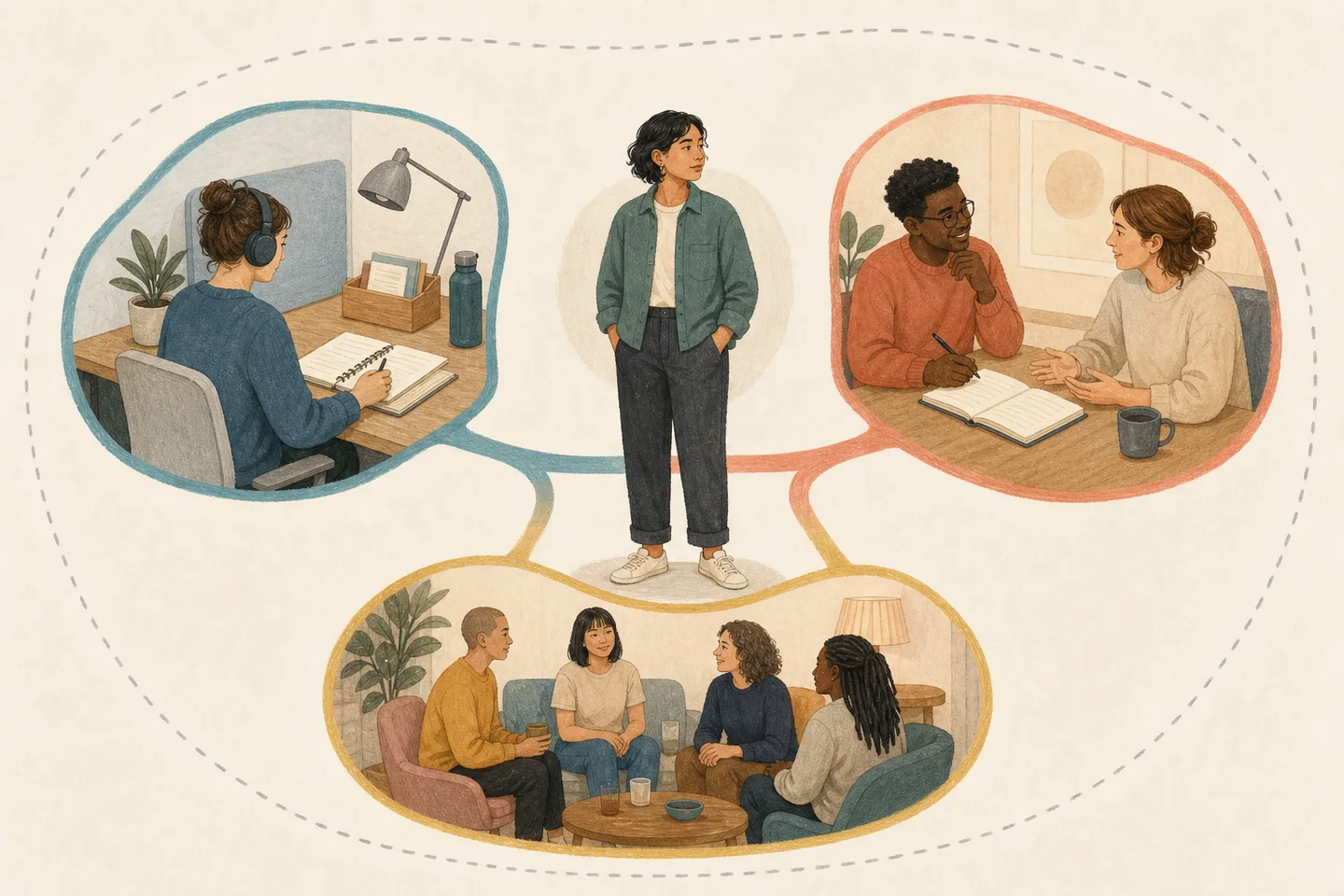
Relief may sit beside grief, anger, doubt, or regret. No emotional response or timetable is required. Keep the report, note your questions, and ask the assessor to explain unfamiliar wording or recommendations.
- 1
Give the result time
Notice your response without forcing it to be positive. Mixed emotions do not make the diagnosis less meaningful.
- 2
Name the strain
Write down the environments, tasks, sensory demands, or communication patterns that make daily life harder.
- 3
Choose one adjustment
Try one practical change at home, work, education, or healthcare appointments, then observe whether it helps.
- 4
Look for a good support fit
Consider autism-informed professional help, autistic-led groups, or peer support while checking availability and approach.
- 5
Decide separately about disclosure
Share selectively, delay, or decline unless a specific process requires information. A diagnosis does not create a duty to tell everyone.
Continue reading
Explore related articles for the questions you want to understand next.


Frequently asked questions
Adult autism diagnosis questions
What are the benefits of receiving an autism assessment?
An assessment may provide a clinically informed explanation for lifelong patterns, identify needs, guide support conversations, and provide documentation when an organization requires it. These outcomes vary, and assessment can also bring grief or uncertainty.
Is a diagnosis needed to access support?
Not always. Self-education, personal sensory changes, and some peer support do not require a formal diagnosis. Workplaces, schools, insurers, or services may have their own documentation rules, so check the exact requirement first.
Is a formal autism diagnosis worth it as an adult?
It may be worthwhile when professional clarification or documentation could change your care, work, education, or self-understanding. Weigh that goal against cost, waiting time, emotional effort, and privacy preferences.
Can an adult autism diagnosis help with workplace accommodations?
Formal documentation can support a request by explaining functional barriers, but it does not guarantee approval. Requirements and legal standards vary by employer and jurisdiction.
Can self-identification provide some of the same benefits as formal diagnosis?
For goals that do not require clinical confirmation, self-identification may support reflection, low-risk personal adjustments, and community connection. It is not a clinical differential assessment and may not meet formal documentation requirements.
Sources
Research and official guidance
- Corden, Brewer, and Cage (2021). Personal identity after an autism diagnosis
- Kiehl, Pease, and Hackmann (2024). Adult experience of being diagnosed with autism: qualitative meta-synthesis
- Nayyar et al. (2025). Lived experiences of receiving an autism diagnosis in adulthood: systematic review
- NICE (2021). Autism spectrum disorder in adults: diagnosis and management
- Norris, Harvey, and Hull (2025). Post-diagnostic support for adults diagnosed in adulthood
- Stagg and Belcher (2019). Receiving a diagnosis in later life
- U.S. Department of Education. Postsecondary disability rights and responsibilities
- U.S. EEOC. Reasonable accommodation and undue hardship under the ADA
This article provides educational information, not medical diagnosis, legal advice, or a promise of eligibility for any service or accommodation.