
Autistic Fatigue: Signs, Causes, and Why Rest May Not Help
Autistic fatigue is descriptive language for exhaustion some autistic people connect with sustained sensory, social, masking, executive, or everyday demands. It is not a diagnosis, and a poor response to rest does not prove one cause.

The short answer
Rest time and reduced demand are not always the same
Autistic fatigue can affect physical energy, thinking, communication, sensory tolerance, and daily functioning. More sleep may not feel restorative when the demands creating the load continue, sleep quality is poor, pain or distress remains, or another health condition contributes. A demand-and-symptom log can clarify patterns, but it cannot diagnose the cause.
Scope and evidence
What autistic fatigue can and cannot explain
Autistic fatigue is a descriptive term for exhaustion that an autistic person may associate with sustained sensory, social, masking, executive, or everyday demands. It is not a formal diagnosis, not a universal feature of autism, and not a conclusion that can be confirmed by one symptom, timeline, or response to rest. (Ali et al., 2025; National Autistic Society, 2020)
More sleep or time away from work may not feel restorative when the demands consuming capacity remain active, sleep quality is poor, pain or distress continues, or another health condition contributes. A poor response to rest does not prove autistic burnout. Persistent, worsening, or unexplained fatigue deserves medical attention because autistic demand patterns and medical or mental-health causes can coexist. (MedlinePlus, 2025)
This guide helps you compare changes with your own sustainable baseline, distinguish recurring fatigue from ordinary tiredness, shutdown, and broader burnout, then map hidden sources of load. Its five-field log is an editorial observation aid, not a validated scale or medical test.
Key takeaways
Five points to keep in view
- Autistic fatigue is descriptive language, not a diagnosis or a universal autism symptom.
- Look for change from your own sustainable baseline, not a universal symptom checklist.
- Rest may help less when sensory, social, masking, decision, or communication demands remain active.
- Fatigue, shutdown, burnout, depression, sleep problems, medication effects, and physical illness can overlap.
- Persistent, worsening, new, or unexplained fatigue deserves medical evaluation rather than automatic attribution to autism.
On this page
Read in order or jump to what you need
- What Is Autistic Fatigue?
- Signs of Autistic Fatigue in Adults
- Autistic Fatigue, Shutdown, and Burnout Are Not Identical
- Why Rest or Sleep May Not Fix Autistic Fatigue
- Map the Hidden Load Before You Add More Rest
- What May Help When Energy Is Already Low
- When Fatigue May Need Medical Evaluation
- How to Explain Autistic Fatigue to Other People
- Frequently Asked Questions
- Conclusion
- References
Definition
What is autistic fatigue?
Autistic fatigue is descriptive language for a deep loss of physical, cognitive, sensory, or social capacity that some autistic people connect with sustained demands. A 2025 systematic review synthesized 48 studies with roughly 4,000 autistic participants, but it examined autistic burnout rather than establishing a diagnosis for autistic fatigue.
A useful description, not a diagnosis
Autism guidance and qualitative research describe sensory load, social effort, masking, and everyday expectations as possible contributors. (National Autistic Society, 2020; Pryke-Hobbes et al., 2023) The phrase can describe a pattern in which routine tasks take more effort, conversation becomes harder, or sensory input becomes less tolerable. It cannot confirm the cause.
When the change follows a conversation, gathering, or other interaction, the social fatigue in autism guide maps the full event arc and the capacity that disappears afterward.
Why it is not laziness or a character flaw
Laziness implies unwillingness. Fatigue describes reduced capacity. A person may want to cook, answer a message, or leave the house while lacking the energy, processing speed, speech, or sensory tolerance needed. Outward performance may hide that cost until the person gets home.
Instead of asking whether someone is trying hard enough, ask: "What demand is using capacity, and what changed from this person's sustainable baseline?"
Three terms used in this guide
- Autistic fatigue: a non-diagnostic term for fatigue some autistic people associate with sustained demands.
- Sustainable baseline: a level of activity and participation a person can maintain without repeated depletion.
- Autistic burnout: a community-originated research construct involving broader exhaustion, loss of function, and reduced tolerance to stimulus. (Raymaker et al., 2020)
Personal baseline
Signs of autistic fatigue in adults
Autistic fatigue can appear as a drop in physical, thinking, sensory, communication, or daily-life capacity. Ask what has become harder than it is at your usual sustainable baseline. These are observation domains, not a diagnostic checklist.
| Domain | What a change may look like | Baseline question |
|---|---|---|
| Physical | Slower movement, heaviness, or shorter endurance | Is this activity harder than usual? |
| Thinking | More trouble starting, switching, sequencing, or deciding | Has the effort of familiar tasks changed? |
| Sensory and communication | Lower input tolerance or more effortful speech | Which demands now cost more? |
| Daily function | Less capacity for meals, hygiene, messages, or home life | What is being dropped or delayed? |
Physical energy and movement
Standing, preparing food, showering, or moving between places may take more recovery time. These changes matter most when they are new, repeated, or more intense than the person's ordinary variation.
Thinking and executive function
"Brain fog" can look like rereading a sentence, losing track halfway through a routine, retrieving words more slowly, or being unable to choose between familiar options. These are observable changes, not proof of one cause.
Sensory, emotional, and communication capacity
Sounds, light, touch, busy conversation, or competing sensory input may become harder to tolerate. Speech can require more effort, while irritability, tears, or withdrawal may appear sooner under load. Workplace research describes masking as cognitively demanding and exhausting for some autistic adults. (Pryke-Hobbes et al., 2023)
Daily function and change from baseline
Someone may keep performing at work while losing capacity for food, hygiene, household tasks, or relationships afterward. A single difficult day says less than a recurring shift in what the person can sustain and how long recovery takes.
Compare the pattern
Autistic fatigue, shutdown, and burnout are not identical
The patterns below can overlap, but they are not interchangeable labels or fixed stages. Ask what changed, how long it lasted, how broad the functional effect was, and which demands came before it.
| Pattern | Relationship to demand | What you may observe | What it can tell you |
|---|---|---|---|
| Ordinary tiredness | Often follows missed sleep or short-term effort | Lower energy with most usual abilities still available | Improvement after sleep supports a short-term explanation but proves no cause |
| Acute overload or shutdown | Often appears during or soon after intense input | Speech, movement, processing, or response capacity may narrow abruptly | Reducing immediate input may help; timing and recovery vary |
| Recurring autistic fatigue | Repeats around sensory, social, masking, executive, or transition load | Energy and thinking may drop with communication or daily function | A repeated pattern is useful to record but is not a diagnosis |
| Broader autistic burnout | More pervasive exhaustion and functional change | Reduced access to skills and lower input tolerance may persist | The pattern warrants lower demands and review of overlapping causes |
A 2025 systematic review and earlier community-partnered research identified severe exhaustion, reduced functioning, and lower tolerance to stimulus as recurring burnout themes. Applying those findings to autistic fatigue is an inference, not a diagnostic rule.
Ordinary tiredness
Ordinary tiredness tends to be shorter and more proportionate to recent effort. Failure to recover quickly does not automatically place an experience in another category.
Acute overload or shutdown
A shutdown is better understood as an acute response pattern than as a synonym for ongoing fatigue. Someone may become quiet, slow, unable to decide, or temporarily unable to continue after too much input. An episode can leave fatigue afterward.
Recurring autistic fatigue
Capacity may fall repeatedly after particular demands, sometimes with a delay. Looking across several episodes is more useful than naming one hard afternoon because it shows whether similar loads repeatedly precede the change.
Broader autistic burnout
Burnout generally points to a wider, more sustained loss of capacity than one episode of fatigue. The autistic burnout overview owns that deeper definition; this page stays focused on fatigue, rest response, and safer decision support.
The central distinction
Why rest or sleep may not fix autistic fatigue
Rest can miss the source of autistic fatigue when sensory input, social expectations, decisions, or recovery from sustained masking continue. A quiet-looking hour is not necessarily a low-demand hour. Poor sleep, pain, distress, medication effects, or health conditions can also contribute, so an incomplete response to rest does not identify one cause.
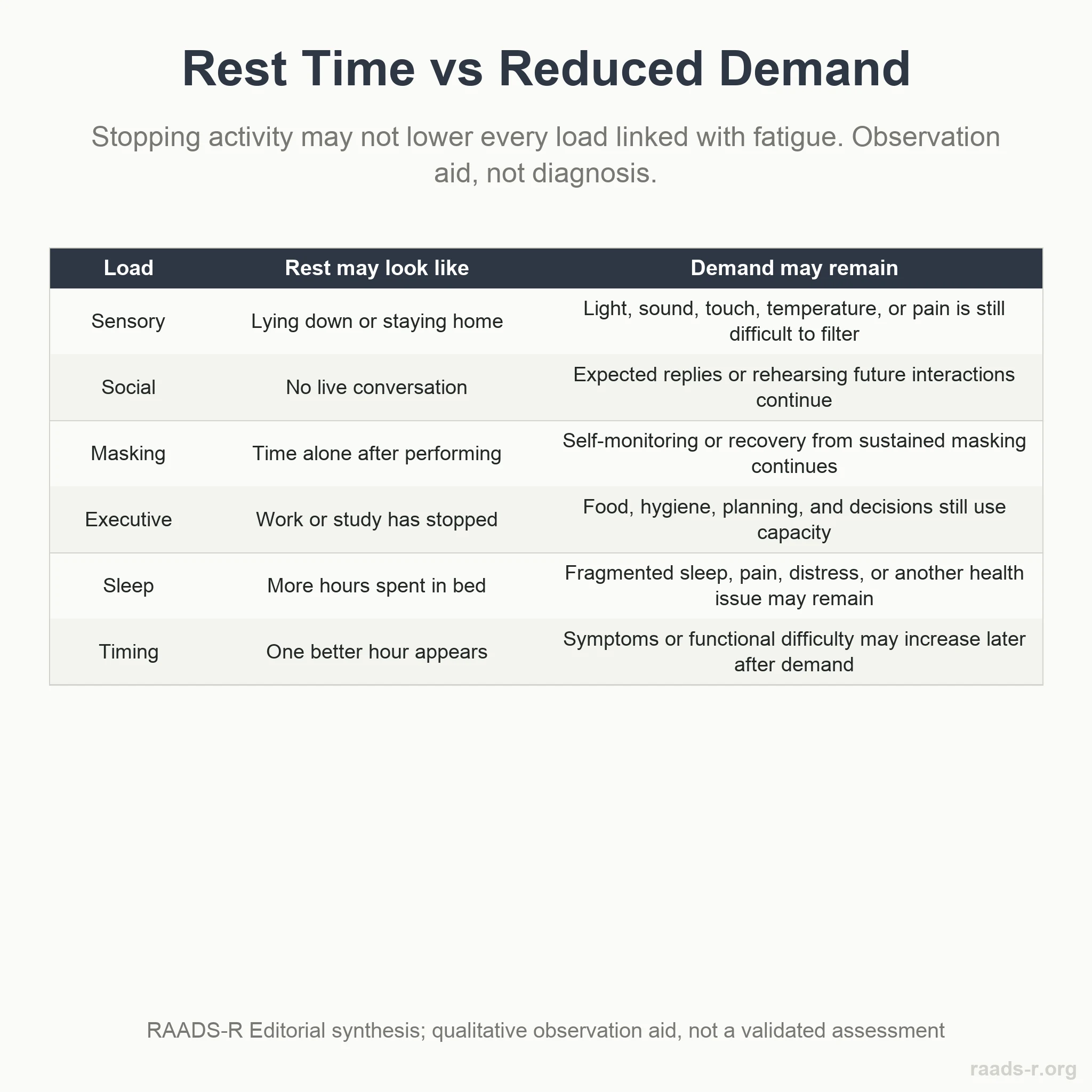
Activity stopped, but total demand did not
Stopping work removes one activity, but task switching, food planning, messages, and the next obligation may remain. Ask two separate questions: "How long did I rest?" and "Which demands became smaller?"
Sensory, social, and decision load can continue
A person may be alone yet still contend with light, sound, temperature, pain, expected replies, rehearsed conversations, or basic-care choices. In that situation, activity stopped but the underlying load did not necessarily fall.
Sleep duration is not the same as restorative sleep
More time in bed does not guarantee refreshing sleep. Fragmented sleep, pain, emotional distress, sleep disorders, medicines, or other health problems may leave fatigue in place. (CDC, 2024; MedlinePlus, 2025)
A better hour can hide delayed effects
One easier hour can prompt a return to chores before the cost of earlier demand becomes clear. Delayed worsening after activity can occur with ME/CFS, so timing alone cannot label the pattern autistic fatigue. Record the demand, symptoms, delay, and recovery response rather than judging the day by its best moment.
Low-energy next steps
What may help when energy is already low
When autistic fatigue is already draining capacity, reduce demands before adding recovery tasks. These are low-risk experiments, not treatment or a test of whether fatigue is "really" autistic.
What to do today
- Postpone one non-urgent task, shorten an interaction, or ask someone else to handle one decision.
- Reduce noise, light, notifications, uncomfortable clothing, or conversation where possible.
- Follow your usual plan for food, fluids, and prescribed medication; leave optional work unfinished.
What to change this week
- Review the log for repeated links among demands, symptoms, delayed effects, and recovery.
- Request one concrete change, such as written instructions, fewer transitions, or protected quiet time.
- Arrange medical review if fatigue persists, worsens, or remains unexplained.
A 2025 systematic review found that rest, solitude, sensory relief, and individual or community support were among factors people associated with recovery from autistic burnout. That finding provides context for low-risk experiments. It is not a treatment protocol or proof that one change will resolve fatigue.
Do not spend a better day all at once
Treat a better hour as information, not proof that capacity has returned. Resume less than feels available, keep recovery time uncommitted, and record how you feel later and the next day. If fatigue sits within broader functional loss, use the longer guide to how to recover from autistic burnout.
Health boundary
When fatigue may need medical evaluation
Persistent autistic fatigue deserves medical review when it keeps limiting daily life, worsens, or remains unexplained after adequate opportunity for sleep and lower demand. MedlinePlus guidance lists medicines, pain, sleep disorders, depression, anemia, iron deficiency, and thyroid disease among possible contributors. An autism-linked pattern should not close the medical question.
Keep more than one explanation open
Sensory strain, masking, or repeated social demand may be part of the pattern without being the whole explanation. One contributor does not cancel another. A clinician can decide whether an examination, sleep assessment, medication review, or tests are appropriate.
Patterns worth describing to a clinician
Record when fatigue began, whether it is constant or episodic, and how it changes daily tasks. Include sleep quality, pain, medication changes, appetite, recent illness, and mood. Mention delayed worsening after activity or symptoms triggered by standing, such as lightheadedness, a fast heartbeat, breathlessness, or thinking difficulty. These are useful clinical details, not proof of ME/CFS or dysautonomia.
When to seek urgent help
Contact a clinician promptly if fatigue comes with confusion or dizziness, blurred vision, little or no urine, recent swelling and weight gain, or thoughts of self-harm. If anyone is in immediate danger, use local emergency services or the crisis service available where they live. (MedlinePlus, 2025)
For a deeper comparison of fatigue, mood, sensory change, and coexistence, see autistic burnout vs depression.
Communication scripts
How to explain autistic fatigue to other people
Because autistic fatigue is descriptive language, a useful explanation names observable change, its effect on daily function, and the adjustment you want to try. It leaves room for medical evaluation and does not ask another person to accept a self-diagnosis.
For a clinician
"For the past few weeks, I have needed much longer to recover after ordinary work and social demands. My speech, concentration, and self-care drop when exhaustion peaks. Sleep has not returned me to my usual baseline. Could we review possible causes and what I should track?"
For a family member or partner
"I am not asking you to decide what caused the exhaustion. My capacity has changed. For now, fewer decisions, quieter time, and help with one routine task would reduce the load while I work out what is happening."
For work or school
"My current energy and processing capacity are lower than usual, especially after meetings, noise, or rapid task switching. Could we try written instructions, fewer interruptions, a quieter setting, or adjusted timing, then review whether those changes help?"
Clear, explicit communication can also reduce the work of cross-neurotype guesswork. The double empathy problem guide explains why misunderstandings can be two-way rather than proof that one person failed to communicate.
Continue reading
Explore related articles for the questions you want to understand next.


Common questions
Autistic fatigue FAQ
Can autism cause extreme fatigue?
Autistic people may describe extreme fatigue after sustained sensory, social, masking, communication, or executive demands. The phrase autistic fatigue names that experience but cannot establish the cause. Persistent or worsening exhaustion deserves medical review because poor sleep, pain, depression, medication effects, or physical illness may also contribute.
What is the difference between an autistic shutdown and burnout?
A shutdown usually describes an acute overload response with reduced speech, movement, or interaction. Burnout is a broader, longer pattern of exhaustion and reduced functioning. Neither description is a self-diagnostic test, and both can overlap with other explanations.
What are the common symptoms of high functioning autism in female adults?
High functioning is imprecise, outdated language because outward performance can hide support needs. Some women report masking, scripted social behavior, sensory strain, reliance on routines, or exhaustion after interaction. No pattern alone confirms autism.
What do autistic meltdowns look like?
A meltdown is an involuntary response to overwhelm, not misconduct. It may involve crying, shouting, pacing, escape, or lost communication. Behavior varies by person and cannot identify the cause by itself.
Can autistic fatigue and a medical condition coexist?
Yes. Demand-linked exhaustion can coexist with sleep disorders, depression, anemia, thyroid disease, ME/CFS, dysautonomia, pain, or medication effects. Record timing and accompanying symptoms for a clinician rather than assuming one explanation.
Does a RAADS-R result explain fatigue?
No. RAADS-R screens for autistic traits. It does not diagnose autism, fatigue, shutdown, or burnout, and it cannot explain exhaustion. Discuss fatigue symptoms and functional changes separately with a qualified clinician.
The bottom line
Validate the fatigue without closing the question
Autistic fatigue deserves validation without premature certainty. Depletion after sensory, social, masking, or executive demands can be real even when its cause is unclear. Ask not only "How much longer should I rest?" but also "Which demands remain active while I am resting?"
A short pattern log can connect demands and symptoms with delayed effects and recovery. It may show that quiet, fewer choices, less masking, or more time changes capacity. It may also reveal persistent or worsening fatigue with no clear link to demand. Keep other explanations open and share the pattern with a clinician when medical evaluation makes sense.
Rest becomes more useful when the load actually falls. Track what drains capacity, what restores it, and what does not.
Start small. Lower one avoidable demand and record the result. Reassess before spending a better hour all at once.
Editorial review: Reviewed and updated in September 2026 by RAADS-R Editorial against peer-reviewed and official sources. No named clinician reviewer is claimed. This article provides general education, not medical advice, diagnosis, or individualized treatment.
Research sources
Peer-reviewed and official sources
- Ali, D., Bougoure, M., Cooper, B., Quinton, A. M. G., Tan, D., Brett, J., Mandy, W., Maybery, M., Magiati, I., & Happé, F. (2025). Burnout as experienced by autistic people: A systematic review. Clinical Psychology Review, 122, 102669. https://doi.org/10.1016/j.cpr.2025.102669
- Ali, D., Mandy, W., & Happé, F. (2026). How does ‘autistic burnout’ feel? A qualitative study exploring experiences of earlier and later-diagnosed autistic adults. Autism, 30(4), 1014-1027. https://doi.org/10.1177/13623613261422117
- Centers for Disease Control and Prevention. (2024). Symptoms of ME/CFS. https://www.cdc.gov/me-cfs/signs-symptoms/index.html
- MedlinePlus. (2025). Fatigue. U.S. National Library of Medicine. https://medlineplus.gov/ency/article/003088.htm
- National Autistic Society. (2020). Autistic fatigue: A guide for autistic adults. https://www.autism.org.uk/advice-and-guidance/mental-health/autistic-fatigue/autistic-adults
- National Autistic Society. (2020). Meltdowns: A guide for all audiences. https://www.autism.org.uk/advice-and-guidance/behaviour/meltdowns/all-audiences
- National Institutes of Health. (2023). Recognizing POTS. NIH News in Health. https://newsinhealth.nih.gov/2023/09/recognizing-pots
- Pryke-Hobbes, A., Davies, J., Heasman, B., Livesey, A., Walker, A., Pellicano, E., & Remington, A. (2023). The workplace masking experiences of autistic, non-autistic neurodivergent and neurotypical adults in the UK. PLOS ONE, 18(9), e0290001. https://doi.org/10.1371/journal.pone.0290001
- Raymaker, D. M., Teo, A. R., Steckler, N. A., Lentz, B., Scharer, M., Delos Santos, A., Kapp, S. K., Hunter, M., Joyce, A., & Nicolaidis, C. (2020). “Having all of your internal resources exhausted beyond measure and being left with no clean-up crew”: Defining autistic burnout. Autism in Adulthood, 2(2), 132-143. https://doi.org/10.1089/aut.2019.0079
- Ritvo, R. A., Ritvo, E. R., Guthrie, D., Ritvo, M. J., Hufnagel, D. H., McMahon, W., Tonge, B., Mataix-Cols, D., Jassi, A., Attwood, T., & Eloff, J. (2011). The Ritvo Autism Asperger Diagnostic Scale-Revised (RAADS-R): A scale to assist the diagnosis of autism spectrum disorder in adults. Journal of Autism and Developmental Disorders, 41(8), 1076-1089. https://doi.org/10.1007/s10803-010-1133-5