
Autistic Burnout vs Depression: Differences and Overlap
Autistic burnout vs depression is not always an either-or question. Both can involve exhaustion, withdrawal, and reduced functioning. This evidence-led comparison explains what may organize a clinical conversation, why the two can coexist, and why no online checklist can diagnose either one.

Abstract
The comparison in one evidence-led view
Autistic burnout vs depression is not always an either-or question. Both can involve exhaustion, withdrawal, and reduced functioning. Autistic burnout is an emerging research and lived-experience construct associated with prolonged demands, loss of capacity, and lower tolerance for input. Depression is a clinical condition that can affect mood, interest or pleasure, thinking, sleep, energy, and daily functioning.
The two can coexist. Context, capacity, mood and interest, sensory tolerance, time course, and responses to reduced demands may organize observations, but they cannot choose a diagnosis. Persistent, severe, worsening, function-limiting, or safety-related changes need appropriate clinical assessment.
On this page
Autistic burnout vs depression: From evidence to safer next steps
Step 1 · Build the first concept
What is autistic burnout?
Autistic burnout describes prolonged exhaustion, reduced access to previously available skills, and lower tolerance for sensory or social demands (Raymaker et al., 2020; Higgins et al., 2021; Ali et al., 2025). Researchers and autistic adults connect it with accumulated strain and mismatched support, but current definition and measurement studies do not provide a clinically validated diagnostic rule.
A 2021 lived-experience Delphi study called for clearer separation from depression, chronic fatigue, and non-autistic burnout. A 2025 systematic review synthesized 48 studies involving approximately 4,000 autistic participants. The review found recurring exhaustion and increased disability, while also noting that samples were disproportionately White, female, late-diagnosed, and average-or-higher in intellectual or verbal ability. That limits generalization across autistic populations (Higgins et al., 2021; Ali et al., 2025).
2020 foundation
19 interviews + 19 public sources
The qualitative study proposed chronic exhaustion, loss of skills, and reduced tolerance to stimulus as central themes, not diagnostic criteria.
2025 review
48 studies and about 4,000 participants
The review found recurring themes while documenting variable definitions and limited sample representation.
2026 measurement
379 autistic adults
The AASPIRE measure showed promising research properties and correlations with depression, anxiety, camouflaging, and occupational burnout, but it is not a diagnostic test.
For a broader discussion of signs, contributing pressures, immediate support, and recovery considerations, use the separate autistic burnout in adults guide. This comparison page stays focused on overlap and context.
The plain-language definition used on this page
- Autistic burnout: a developing research construct for sustained exhaustion, reduced function, and lower tolerance for demands.
- Research measure: a standardized tool for studying a construct consistently, not a clinical diagnosis.
Step 2 · Build the second concept
What is depression?
Depression is broader than visible sadness. It may involve a persistent low, empty, or irritable mood, or loss of interest or pleasure. WHO guidance describes a depressive episode as depressed mood or loss of interest or pleasure for most of the day, nearly every day, for at least two weeks, with disruption to family, social, educational, or work life. Diagnosis requires professional evaluation (World Health Organization, 2025).
Mood, interest, and pleasure
Emotional numbness may replace visible sadness. Anhedonia means reduced ability to feel interest or pleasure; it is an educational term, not a self-diagnosis. Withdrawal may reflect low drive, hopelessness, shame, exhaustion, sensory overload, or more than one process.
Cognitive, physical, and functional changes
Depression can disrupt sleep, appetite, energy, concentration, hope, and daily functioning. Thoughts of death or suicide may occur. The National Institute of Mental Health recommends professional assessment that can weigh mood and impairment alongside physical health, medication effects, sleep, and substance use (World Health Organization, 2025; National Institute of Mental Health, 2024).
Recognition in autistic adults
Fatigue, withdrawal, reduced speech, or disrupted routines may be attributed too quickly to autism or burnout. A 2018 systematic review found limited validation evidence for common depression self-report tools in autistic adults. That supports contextual clinical interpretation, not rejecting screening. Discuss baseline communication, masking, sensory load, changes in interest, and trusted input when wanted.
Step 3 · Understand the overlap
Why autistic burnout and depression can look alike—or coexist
Exhaustion, withdrawal, sleep disruption, thinking difficulty, and reduced functioning may appear in autistic burnout, depression, or both. Appearance alone does not identify the process behind a change.
| Shared change | Possibly relevant context | What it cannot prove |
|---|---|---|
| Exhaustion | Sustained demands, low mood, illness, pain, or sleep loss | Which condition is present |
| Withdrawal | Sensory overload, reduced interest, fear, shame, or need for recovery | Why someone is pulling back |
| Sleep disruption | Stress, depression, anxiety, medication, or physical health | A specific cause |
| Thinking difficulty | Overload, depression, ADHD, poor sleep, or illness | Which process drives the difficulty |
| Reduced functioning | Lower capacity, mood change, physical illness, or several contributors | That one condition explains everything |
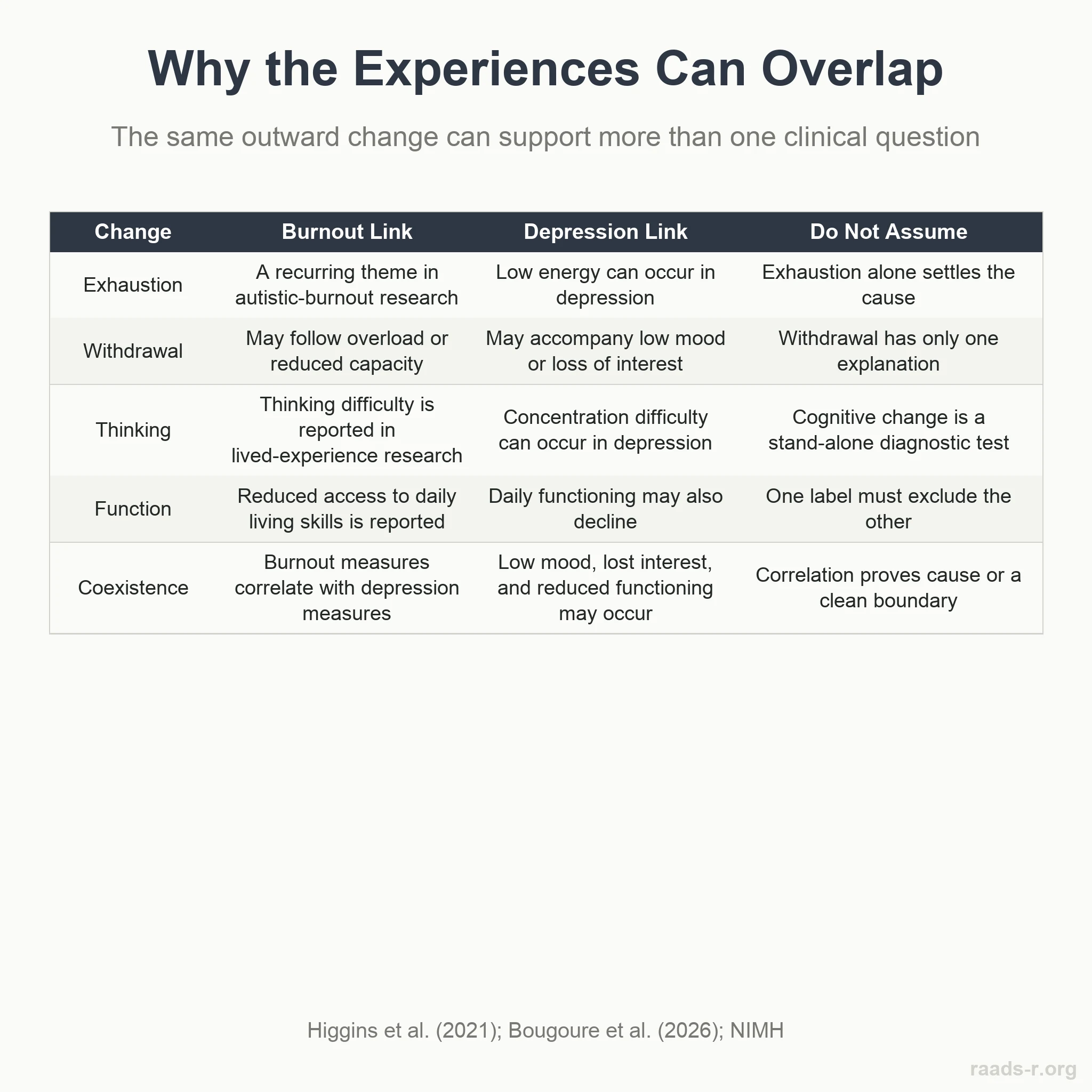
Correlation is not a diagnostic rule
A 2026 cross-sectional study of 92 autistic adults found an association between burnout-exhaustion and depression. Its online, self-selected sample and adapted scale support overlap, not causality, prevalence, or a diagnostic rule. The 2026 AASPIRE study of 379 autistic adults also found correlations with depression, anxiety, camouflaging, and occupational burnout.
Both explanations may need attention when capacity loss follows demands alongside persistent low mood or loss of interest. Sleep, medication, substance use, trauma, anxiety, ADHD, and physical health may also affect mood, energy, or functioning. A clinician can review these factors without forcing one label to explain everything. The guide to what can affect RAADS-R results explains why current state and lifelong traits should remain conceptually separate.
Step 4 · Compare the two concepts
Autistic burnout vs depression: a side-by-side view
Now that each concept is clear, compare them without treating the table as a test. Autistic burnout research emphasizes sustained exhaustion, reduced access to skills or functioning, and lower tolerance for sensory or social input. Depression evaluation centers persistent low mood or loss of interest or pleasure, associated symptoms, impairment, and professional assessment. They may overlap or coexist (Raymaker et al., 2020; World Health Organization, 2025; Benatov et al., 2026; Bougoure et al., 2026).
| Dimension | Autistic burnout | Depression | Caution |
|---|---|---|---|
| Context | Often described in relation to accumulated demands, sensory load, masking, and limited support | May develop with or without one clear external trigger | Context organizes questions; it does not diagnose |
| Capacity | Chronic exhaustion, skill loss, and lower stimulus tolerance are reported | Energy and daily functioning may also decline | Reduced capacity is not unique to one explanation |
| Mood and interest | Foundational descriptions emphasize exhaustion, skills, and tolerance for input | Depressed mood or loss of interest or pleasure is central to evaluation | Either pattern may coexist with the other |
| Sensory tolerance | A marked drop in tolerance for sound, light, touch, communication, or social input is often reported | Sensory change is not a defining depression criterion, but it may still occur | Sensory change alone cannot identify the cause |
| Reduced demands | Some participants report benefit from lower demands, sensory relief, acceptance, and support | Rest or temporary improvement does not rule depression in or out | A response is informative, not confirmatory |
| Evidence status | An emerging construct with developing definitions and measures | A recognized clinical condition with established guidance | Different evidence status does not make distress less important |
Step 5 · Turn comparison into observations
Autistic burnout or depression: differences worth recording
Record patterns instead of scoring competing symptom lists. Context can inform a clinical conversation, but it cannot settle a diagnosis.
| Observation | Pattern worth recording | Conclusion to avoid |
|---|---|---|
| Preceding context | Cumulative demands, masking, sensory load, loss, illness, or another stressor | The context proves one explanation |
| Capacity and familiar skills | Which tasks or skills became unavailable, effortful, or inconsistent | Reduced capacity is unique to autistic burnout |
| Mood and interest | Depressed mood or less interest or pleasure, including in lower-demand settings | Preserved interest rules out depression |
| Sensory tolerance and communication | Changes in sound, light, touch, speech, or processing | These changes identify one condition |
| Time course | Onset, persistence, and fluctuation in relation to demands | Duration alone confirms a label |
| Response to reduced demands | What changed after rest, support, fewer expectations, or sensory relief | Brief improvement proves burnout or excludes depression |
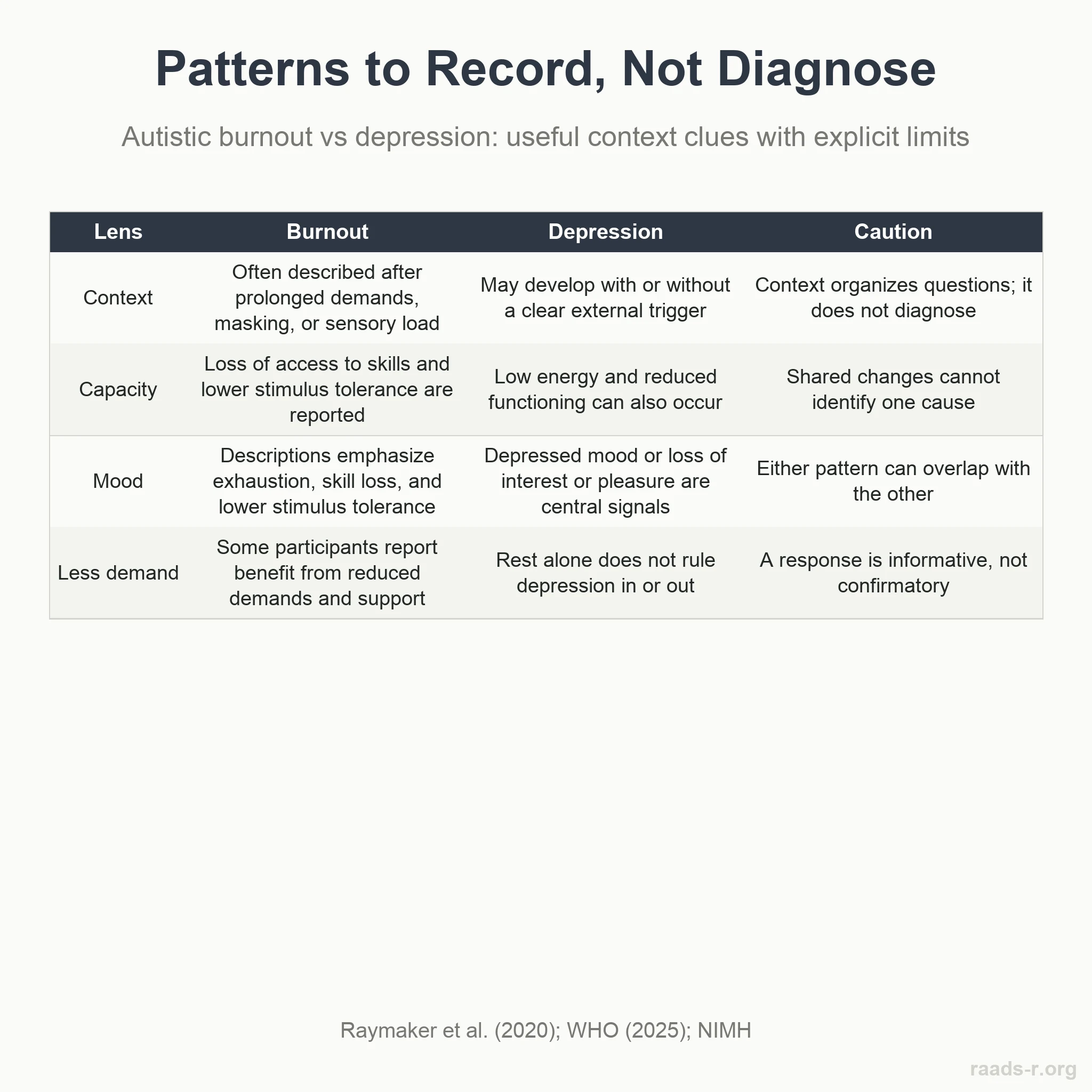
Loss of capacity versus loss of interest
Loss of capacity and loss of interest can sound similar but describe different changes. Depression guidance centers depressed mood or loss of interest or pleasure, with persistence and impairment. Autistic-burnout research describes reduced stimulus tolerance and loss of previously available skills. The distinction is a lens, not a test, and both patterns can appear together.
Time course and reduced demands
Track whether changes follow accumulated demands, persist in quieter periods, or shift with support. Reported recovery supports are associations, not diagnostic responses (Raymaker et al., 2020; Ali et al., 2025).
No observation rules out coexisting conditions. Sleep problems, illness, medication effects, trauma, anxiety, ADHD, substance use, and physical-health factors may complicate the picture. Record concrete changes and bring them to a clinician without turning uncertainty into a verdict.
Step 6 · Review your pattern in order
A guided pattern check before choosing a label
A pattern log cannot decide autistic burnout vs depression. It keeps changes in demands and capacity separate from changes in mood, interest, and pleasure, so one observation such as exhaustion is less likely to become a diagnosis by default.
Work through these questions in order:
- Start with your usual baseline. Over the past three months, what has become harder, less available, or more effortful than usual for you?
- Reconstruct what came before. Note masking, sensory load, workload, social demands, loss, illness, sleep disruption, medication changes, or other stressors.
- Separate capacity from interest. Are you still drawn to meaningful activities but unable to access the capacity, or has interest or pleasure also faded across settings?
- Check sensory and communication changes. Record changes in sound, light, touch, speech, processing, meltdowns, shutdowns, or recovery needs.
- Look across settings and time. Note whether the pattern persists in quieter periods, changes with support, or affects work, home, relationships, and self-care differently.
- Keep coexistence open. Capacity loss after prolonged demands can occur alongside depressed mood, anhedonia, guilt, or hopelessness.
- Check safety before interpretation. Thoughts of death, suicidal intent, inability to stay safe, or life-threatening deterioration require crisis or emergency help—not a more precise label.
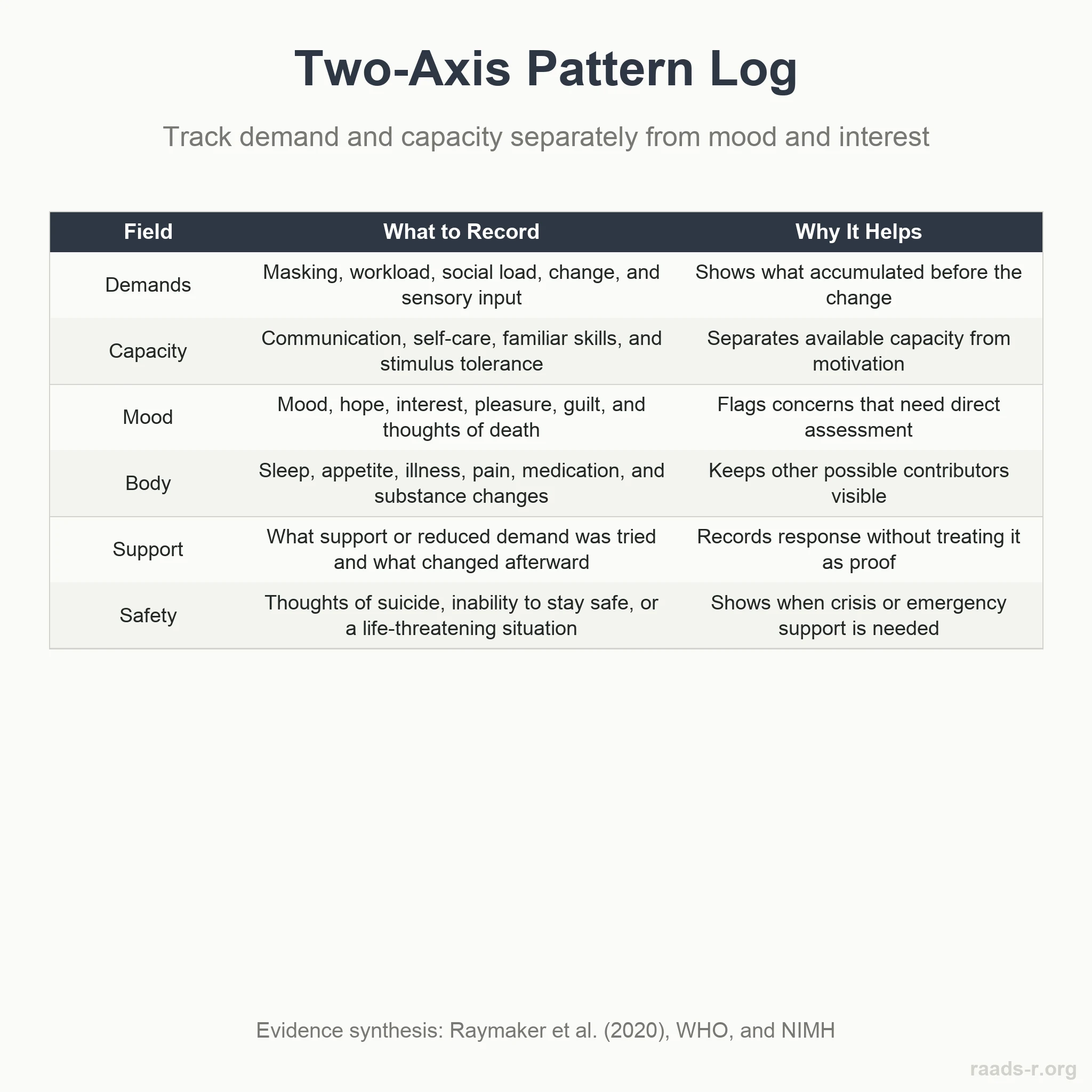
Record what changed after support
Note when each support was tried and what changed afterward. Research links reported recovery with lower demands, sensory relief, acceptance, and support, but these associations do not prove treatment response or rule depression in or out (Raymaker et al., 2020; Ali et al., 2025).
Step 7 · Choose the next action
What to do if it may be burnout, depression, or both
If prolonged demands and reduced capacity are prominent, document which demands can be reduced, where sensory protection or communication support is possible, and what essential responsibilities need help. If persistent low mood, loss of interest or pleasure, hopelessness, or broad impairment is present, arrange a mental-health assessment rather than waiting for rest alone to settle the question.
If the immediate question is what to do with reduced capacity today, use the separate step-by-step guide to how to recover from autistic burnout. It covers basic needs, reducing demands, practical support, work adjustments, gradual re-entry, and the limits of recovery timelines without using response to support as a diagnostic test.
If both patterns may be present, say that directly. A useful clinical summary is: what changed from your baseline, what preceded it, where it occurs, what support you tried, what changed afterward, and whether mood, interest, self-care, or safety also changed. You do not need to prove one label before asking for help.
Capacity and overload
Reduce avoidable load while preserving essentials
Identify demands, sensory inputs, masking pressure, and communication barriers that can be adjusted without assuming this confirms burnout.
Mood and interest
Arrange assessment for persistent depressive changes
Bring examples of low mood, anhedonia, guilt, hopelessness, sleep or appetite changes, and impairment across settings.
Possible coexistence
Ask the clinician to consider both layers
Describe capacity and sensory changes alongside mood, interest, physical health, medication, sleep, trauma, ADHD, anxiety, and substance use.
Keep RAADS-R in its proper scope
The 2011 RAADS-R validation described an instrument intended to assist adult autism assessment. RAADS-R does not assess autistic burnout, depression, treatment needs, or crisis risk (Ritvo et al., 2011). Use the RAADS-R scoring guide as context, not a diagnostic shortcut. The high-score next-step guide explains how to preserve examples before seeking interpretation.
When to arrange assessment
Consider a professional evaluation when the picture remains unclear or changes persist, worsen, or impair daily life. Bring notes about onset, settings, daily tasks, communication, sleep, appetite, health, medication or substance changes, support tried, and any loss of safety or self-care.
A related term
Where occupational burnout fits
WHO classifies burn-out in ICD-11 as an occupational phenomenon resulting from chronic workplace stress that has not been successfully managed. It is not classified as a medical condition and is limited to the work context (World Health Organization, n.d.).
| Lens | Scope | Status | What it cannot establish |
|---|---|---|---|
| Autistic burnout | Broader cumulative load in an autism-related context | Developing research and lived-experience construct | Whether depression, work stress, or another factor also contributes |
| Occupational burnout | Chronic workplace stress | ICD-11 occupational phenomenon, not a medical condition | Whether difficulties beyond work reflect a broader pattern |
| Depression | Mood or interest changes and impairment across settings | Clinical condition requiring evaluation | Whether autistic or occupational burnout also overlaps |
Work stress can contribute to any picture, while low mood, lost interest, or reduced capacity may also appear away from work. All three may overlap. Context across settings can guide a clinical conversation but cannot identify a diagnosis by itself.
Editorial method
How this comparison was reviewed
RAADS-R Editorial checked this page against seven peer-reviewed studies and three official health sources. We prioritized original research, systematic reviews, WHO guidance, and National Institute of Mental Health guidance. Numerical claims were checked against the cited source, and the comparison was edited to keep association, diagnosis, and treatment claims separate.
This page has not been reviewed by a named clinician, and no clinical credential is implied. The organization author is shown in the byline, the update date is visible, and the complete source list appears below. If you find a factual error or a source that no longer resolves, use the contact page so the editorial record can be corrected.
Continue reading
Explore related articles for the questions you want to understand next.


Common questions
Autistic burnout and depression FAQ
How to know if it's depression or autistic burnout?
No single symptom can settle the question. Depression guidance centers persistent low mood or loss of interest or pleasure, impairment, and professional evaluation. Autistic-burnout research describes sustained exhaustion, reduced functioning, and lower stimulus tolerance without settled diagnostic criteria.
What are the symptoms of an autistic shutdown?
Autistic shutdown commonly means withdrawal or reduced responsiveness when demands or input exceed capacity. The term varies and is not a diagnosis; this article does not use it as a formal differential criterion.
Can you recover from autistic burnout?
Recovery varies. Participants associated reduced demands, sensory relief, acceptance, and support with recovery, but these reports do not establish one treatment or prove what caused the decline.
What are the differences between ADHD burnout and autistic burnout?
ADHD burnout is an informal, nonstandard term. Current evidence does not support a clean diagnostic distinction from autistic burnout based on an online checklist. Discuss persistent impairment with a qualified clinician.
Can autistic burnout and depression happen together?
Yes. Shared outward changes do not identify one cause, and association does not prove causation or determine treatment. Professional assessment can consider both without forcing an either-or answer.
Does feeling better after rest prove autistic burnout?
No. Improvement after rest or reduced demands is useful context, but it neither confirms autistic burnout nor rules out depression. Seek evaluation for persistent, severe, worsening, or safety-related changes.
References
Peer-reviewed and official sources
- Ali et al. (2025), systematic review of autistic burnout
- Benatov et al. (2026), burnout-exhaustion and depression in autistic adults
- Bougoure et al. (2026), validation of the AASPIRE Autistic Burnout Measure
- Cassidy et al. (2018), depression measures in autistic adults
- Higgins et al. (2021), lived-experience Delphi definition of autistic burnout
- National Institute of Mental Health, depression
- Raymaker et al. (2020), foundational qualitative study of autistic burnout
- Ritvo et al. (2011), RAADS-R international validation study
- World Health Organization, depressive disorder
- World Health Organization, occupational burnout classification