
Autistic burnout hub
Autistic Burnout Hub for Adults
Autistic burnout can be a useful name for a reported pattern of deep exhaustion, reduced access to everyday functioning, and lower tolerance for input. It is a developing construct, not a standalone diagnosis. Questionnaire scores can describe reported experiences, but cannot establish a diagnosis.

Start here
Follow the guides in a useful order
Begin with the overview, compare overlapping experiences, trace fatigue and accumulated load, then move into recovery.
- 1
Autistic Burnout Hub for Adults
A careful guide to autistic burnout in adults, including signs, overlapping explanations, a seven-field capacity log, and safer next steps.
Read guide - 2
Autistic Burnout vs Depression: Differences and Overlap
Compare autistic burnout and depression, including overlap, observations worth recording, RAADS-R limits, and when to seek professional or urgent help.
Read guide - 3
Autistic Fatigue: Signs, Causes, and Why Rest May Not Help
Understand autistic fatigue, why rest may not restore capacity, what patterns to track, and when persistent fatigue needs medical review.
Read guide - 4
Masking Burnout in Autism: Signs, Causes, and Safer Next Steps
Understand how autistic masking can add to cumulative load, how masking fatigue differs from burnout, and how to reduce masking more safely.
Read guide - 5
Social Fatigue in Autism: Why Socializing Feels Exhausting and How to Recover
Understand why social interaction can drain autistic capacity, how to recognize the pattern, and what to do before, during, and after socializing.
Read guide - 6
How to Recover From Autistic Burnout: A Practical Guide
Learn how to recover from autistic burnout with low-energy steps for basic needs, lower demands, concrete support, gradual re-entry, work, and safety.
Read guide
Understand the pattern
Separate overlap from accumulated load
These guides answer narrower questions that a single burnout overview cannot resolve well.
Compare what you are experiencing

Autistic Burnout vs Depression: Differences and Overlap
Compare autistic burnout and depression, including overlap, observations worth recording, RAADS-R limits, and when to seek professional or urgent help.

Autistic Fatigue: Signs, Causes, and Why Rest May Not Help
Understand autistic fatigue, why rest may not restore capacity, what patterns to track, and when persistent fatigue needs medical review.
Trace where the load is coming from

Masking Burnout in Autism: Signs, Causes, and Safer Next Steps
Understand how autistic masking can add to cumulative load, how masking fatigue differs from burnout, and how to reduce masking more safely.

Social Fatigue in Autism: Why Socializing Feels Exhausting and How to Recover
Understand why social interaction can drain autistic capacity, how to recognize the pattern, and what to do before, during, and after socializing.
Build a safer path forward
Recovery starts with capacity, not productivity
Move from protecting basic needs to reducing avoidable demand, asking for concrete support, and testing re-entry gradually.

Complete evidence guide
Read the full autistic burnout guide
Continue for the evidence boundary, baseline changes, contributing demands, comparisons, immediate support, recovery principles, a seven-field context log, and when to seek help.
Read the burnout overviewThe short answer
Notice a sustained loss of capacity, not one difficult day
If you want a structured starting point, the free Autistic Burnout Test offers 18 original reflection questions about the past two weeks. It is not the ABM or AASPIRE scales and has no clinical cutoff: a higher total only means more reported change, not a cause or a diagnosis.
Current research describes a pattern some autistic people report when sustained demands exceed available capacity and support. Common themes include persistent exhaustion, reduced access to everyday functioning or familiar skills, and lower tolerance for sensory, social, cognitive, or routine demands.
The most useful starting point is a meaningful change from your own more sustainable baseline. Ask what became harder, what demands accumulated, which supports were missing, and what happens after the load changes. Keep depression, sleep disruption, pain, medication effects, illness, trauma-related symptoms, and occupational stress open as possible overlapping or coexisting explanations.
| Question | Useful observation | Conclusion to avoid |
|---|---|---|
| What changed from usual capacity? | Energy, functioning, sensory tolerance, communication, and recovery | One familiar sign proves burnout |
| What preceded the change? | Accumulated demands, transitions, masking, illness, or reduced support | One contributor explains everything |
| What alters the pattern? | Rest, reduced demands, sensory relief, practical help, or time away from work | Improvement confirms a diagnosis |
| What else needs review? | Mood, sleep, physical health, pain, medication, and safety | The closest label rules out other care |
Evidence boundary
What current research can and cannot tell us
A 2025 systematic review brought together 48 studies involving about 4,000 autistic people. It found recurring accounts of exhaustion, reduced functioning, heightened sensory sensitivity, accumulated demands, camouflaging, stigma, and inadequate support. It also found that study samples were not representative of every autistic adult and that definitions and measurement methods varied.
Earlier qualitative work helped establish language for the experience. A foundational 2020 study used 19 interviews and 19 public internet sources to propose chronic exhaustion, loss of functioning, and reduced tolerance to stimuli as central features. Those findings were exploratory, not diagnostic criteria.
Measurement research is still preliminary. A 2024 study of 238 autistic adults evaluated questionnaires intended to study autistic burnout and reported associations with depression, anxiety, stress, fatigue, occupational burnout, and camouflaging. Correlation shows overlap, not that the constructs are interchangeable or that one causes another. The measures do not provide a clinical cutoff for self-diagnosis.
| Evidence stage | What it contributes | Important limit |
|---|---|---|
| 2020 foundational qualitative study | A working description and demand-capacity-support model | Small exploratory base, not universal criteria |
| 2025 review of 48 studies and about 4,000 people | Recurring experiences, contributors, and support themes | Variable definitions and limited sample representation |
| 2024 study of 238 autistic adults | Preliminary measurement and overlap findings | No diagnostic cutoff and more validation needed |
Personal baseline
Five areas where a change may become visible
People vary too much for one universal presentation. Compare current capacity with your own ordinary, more sustainable functioning across several settings and time periods. The five areas below are reflection prompts, not a validated scale.
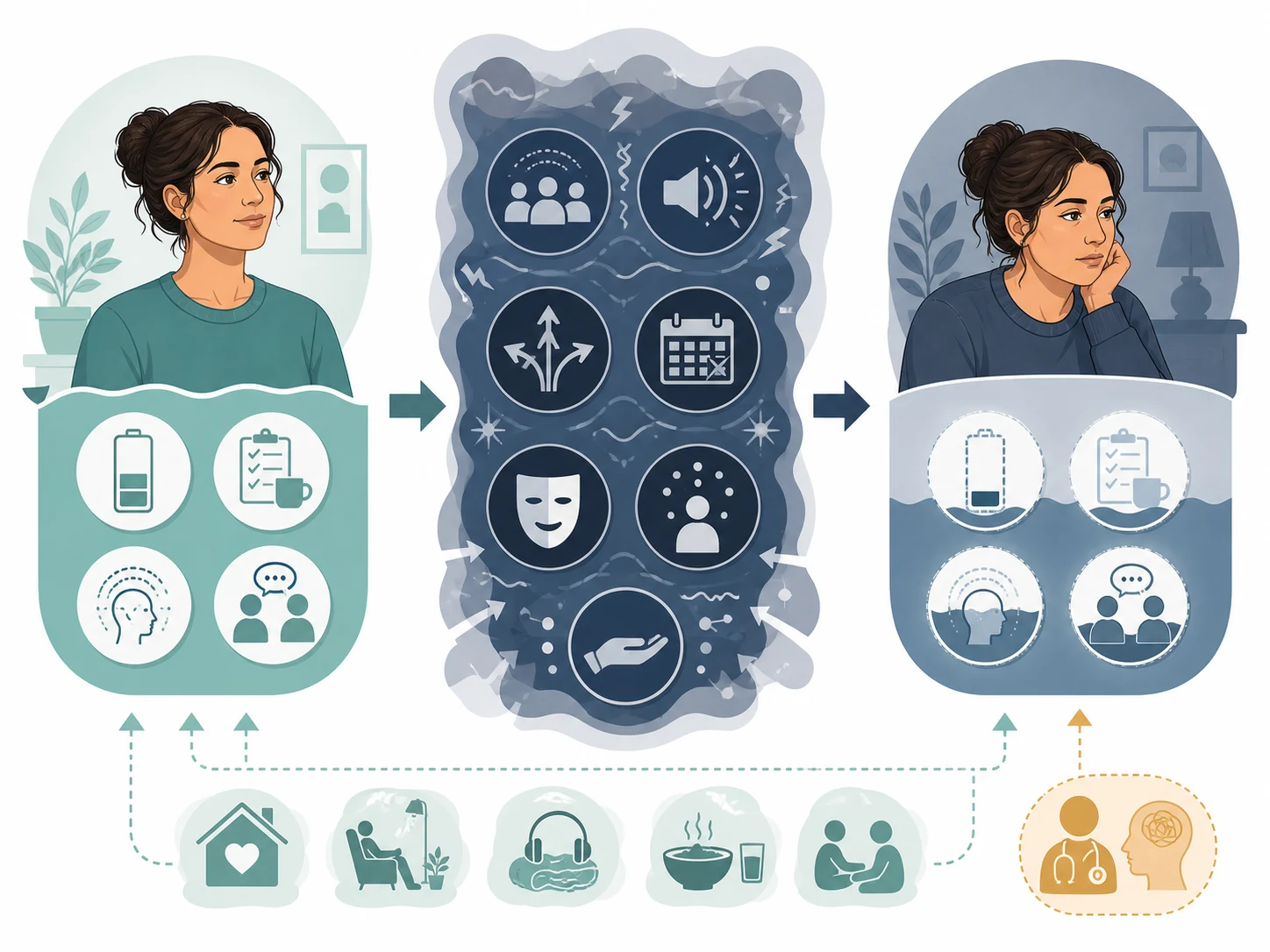
| Baseline area | Possible change | Context worth recording |
|---|---|---|
| Energy | Ordinary demands drain substantially more energy | Sleep, illness, pain, workload, and medication changes |
| Daily functioning | Meals, hygiene, travel, work, or decisions become harder to start or sequence | Which tasks changed, how abruptly, and which help makes a difference |
| Sensory tolerance | Sound, light, touch, crowds, or transitions become harder to tolerate | Setting, intensity, duration, and cumulative input |
| Communication and social capacity | Speech, messages, interaction, or masking take more effort | Communication format, expectations, people present, and recovery afterward |
| Recovery needs | Returning to baseline takes longer or requires more solitude and predictability | What happened before rest, what kind of rest helped, and what remained difficult |
Energy and access to everyday functioning
The shift may feel more pervasive than ordinary tiredness. Familiar routines can remain understood while becoming much harder to initiate, sequence, or complete. That does not mean skills have permanently disappeared. A sudden or medically concerning change should be assessed rather than automatically labeled burnout.
Sensory and communication capacity
Input that was manageable may become harder to filter. Conversation, message composition, spoken language, social monitoring, or transitions may require much more effort. Some people withdraw or need more time alone, but withdrawal is not specific to autistic burnout and can also occur with depression, anxiety, pain, or sleep loss.
Recovery and pattern over time
One difficult afternoon is not enough to establish a sustained pattern. Record ordinary days as well as hard ones. Notice frequency, persistence, after-effects, and whether capacity changes when a specific environment or demand changes. The adult autism signs guide explains why patterns across time and settings are more informative than a single red flag.
Contributors
Why demands can exceed available capacity
Research points to a demand-capacity mismatch, not one universal cause. Several pressures may accumulate while recovery and support remain too limited.
Demand can accumulate through
- • Sensory and social load across the whole day
- • Frequent task switching, decisions, and interruptions
- • Unpredictable transitions or multiple roles
- • Masking, stigma, dismissal, or inaccessible environments
Capacity may be protected by
- • Predictability and genuine recovery time
- • Sensory adjustments and lower communication load
- • Shared practical work and written steps
- • Autonomy, acceptance, and responsive support
Masking can add effort when someone continually monitors speech, expression, movement, or reactions to meet expectations. It is one possible contributor, not the explanation for every person. The separate autism masking guide explores this process without treating it as universal.
The masking burnout guide follows the narrower pathway from environmental pressure and self-monitoring to suppressed needs, delayed recovery, and a shrinking capacity outside the visible role.
Physical and mental-health factors still belong in the picture. Sleep problems, infection, anemia, endocrine or neurological conditions, pain, medication effects, depression, anxiety, and trauma-related symptoms may produce similar changes or add to an existing demand-capacity mismatch. A meaningful personal narrative does not replace differential assessment.
Overlapping explanations
Autistic burnout, depression, and occupational burnout
The experiences can overlap and can occur together. Exhaustion, withdrawal, sleep disruption, reduced functioning, and difficulty meeting daily demands do not reliably separate them.
| Comparison point | Autistic burnout | Occupational burnout | Depression |
|---|---|---|---|
| Typical context | Reported across sensory, social, communication, executive, home, work, and self-care demands | WHO limits the term to chronic workplace stress | A clinical illness affecting mood, interest, thought, sleep, eating, and functioning across settings |
| Commonly reported pattern | Profound exhaustion, reduced access to functioning or skills, and lower tolerance for input | Energy depletion, distance or cynicism toward work, and reduced professional efficacy | Persistent mood or interest changes with cognitive and physical symptoms |
| Useful next question | What demands increased, what capacity changed, and what support was missing? | Does the pattern center on work, and what changes away from work? | Are low mood, loss of pleasure, hopelessness, or other symptoms persistent across contexts? |
| What the comparison cannot do | Confirm a diagnosis or exclude coexisting conditions | Prove work is the only cause | Determine that every loss of capacity is depression |
Improvement after rest, sensory relief, or time away from work is useful observational information, but it is not a diagnostic test. Treating every change as autistic burnout can delay care for depression or physical illness. Treating every change as depression can miss sensory load, masking pressure, accessibility barriers, and practical support needs.
For a focused side-by-side analysis of mood, interest, capacity, sensory tolerance, time course, and coexistence, use the dedicated autistic burnout vs depression comparison. This overview keeps the broader signs, contributors, recovery, and support questions in one place; the comparison page owns the deeper differential intent.
Immediate response
What to do when capacity drops sharply
Aim for stabilization before productivity. Where safely possible, reduce avoidable load and protect basic needs. These are options to adapt around individual needs, disability, responsibilities, and any existing care plan, not a treatment protocol.
- Keep familiar, low-preparation food and a tolerated drink within easier reach.
- Protect a realistic sleep opportunity without assuming sleep will solve the problem.
- Lower noise, light, crowding, transitions, and simultaneous inputs where feasible.
- Switch to written communication, shorter replies, or a temporary status message.
- Triage tasks into needed now, safe to defer, and suitable to share.
- Tell a trusted person what changed and request one concrete form of help.
If medication, shelter, hygiene, food, fluids, or caregiving become hard to maintain, bring support closer rather than waiting for capacity to return. A supporter might reduce choices, prepare supplies, handle selected messages, or remain nearby without requiring conversation. Consent and individual preferences still guide help.
Recovery
Rebuild capacity without promising a timeline
There is no reliable typical recovery time and no validated sequence of stages. A retrospective survey of 141 autistic adults found both shorter and longer reported episodes, while duration and frequency remained unclear. The often-repeated idea that burnout must last at least three months came from early qualitative work, not a universal clinical threshold.
The 2025 systematic review identified reported helpful conditions including rest, reduced demands, sensory relief, solitude, autonomy, acceptance, and practical or community support. These are themes from current studies, not proof that one intervention works for everyone.
| Working focus | Options to discuss or test safely | What to observe |
|---|---|---|
| Stabilize | Protect food, fluids, sleep opportunity, communication access, medication routines, and sensory safety | Which basic needs or inputs are becoming harder to manage? |
| Lower the load | Defer non-urgent tasks, add predictability, share work, and reduce simultaneous demands | Does capacity become more available when a specific demand changes? |
| Re-enter gradually | Try one selected activity in a smaller amount with recovery space | Do signs remain stable, improve, or return afterward? |
| Review support | Keep useful accommodations and reconsider the previous pace | Which conditions are sustainable rather than merely tolerable once? |
For a lower-energy, action-first sequence covering basic needs, demand triage, restorative conditions, support, work, and gradual re-entry, continue with the dedicated guide to how to recover from autistic burnout.
If exhaustion is the main problem and rest has not restored capacity, the autistic fatigue guide separates rest time from actual demand reduction and adds a five-field observation log.
If the cost is concentrated around conversations or gatherings, the social fatigue in autism guide separates the interaction itself from preparation, travel, masking, sensory input, and delayed recovery.
Recovery is not a performance test. Reduced demands may support capacity while assessment or treatment is still needed for coexisting depression, sleep problems, pain, or physical illness. Define progress in practical terms, such as more reliable access to food, communication, rest, or one chosen activity, without promising a cure or deadline.
A practical tool
Use a seven-field capacity and context log
A context log can preserve information that a score loses. Use one row for one event or period, and include ordinary days for comparison. The log helps organize observations; it does not diagnose autistic burnout or determine its cause.
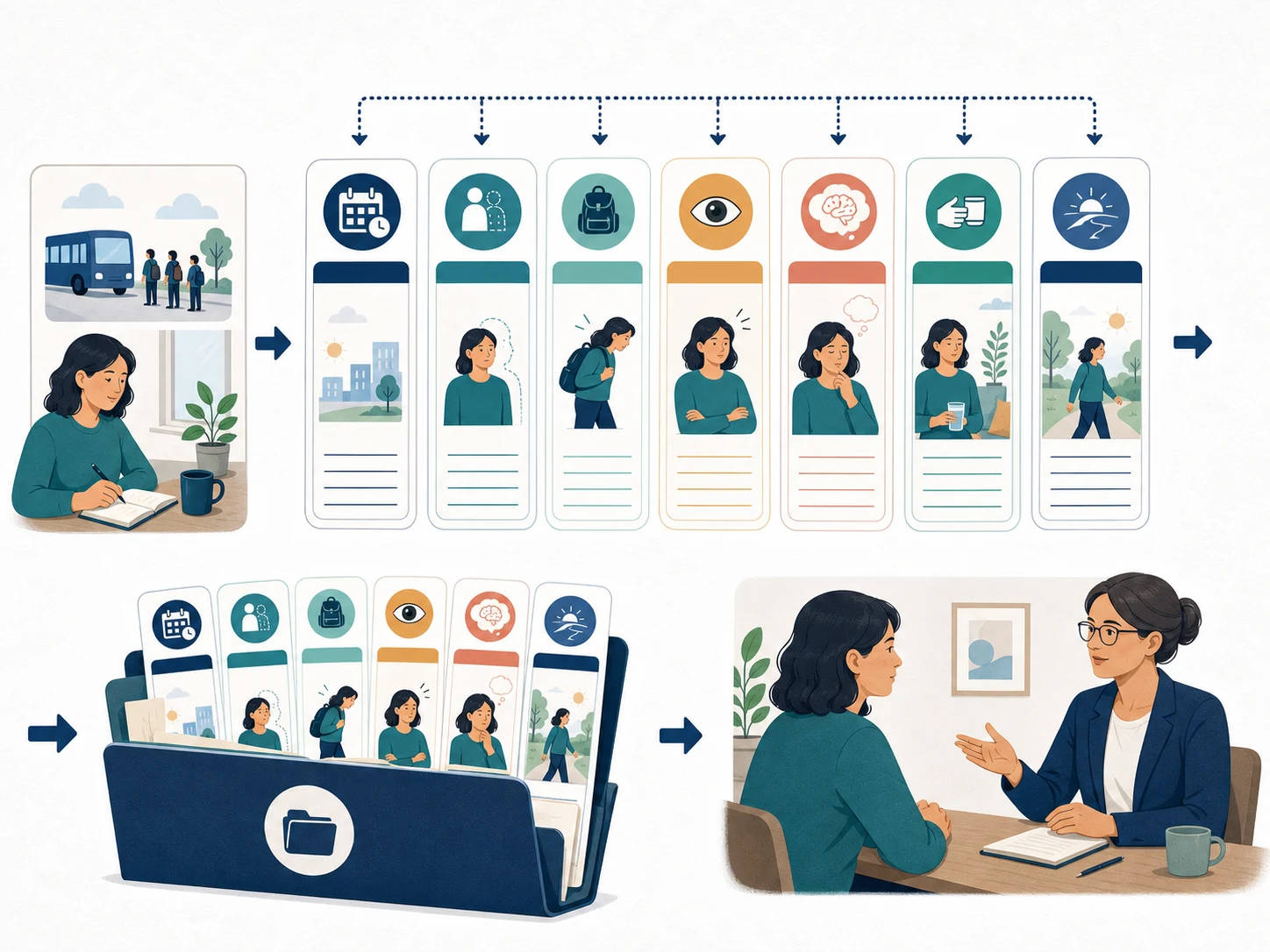
| Date and context | Baseline change | Demand or load | Observable effect | Internal experience | Support or reduction tried | Result and recovery time |
|---|---|---|---|---|---|---|
| When and where? | What differed from usual capacity? | What accumulated beforehand? | What could someone else observe? | What sensations, thoughts, feelings, or access difficulties occurred? | What rest, adjustment, task reduction, or help was tried? | What changed, and approximately how long did recovery take? |
| Thursday after office day | Messages and dinner were much harder than usual | Commute, bright meeting room, changed agenda, five calls | Stopped replying and ate very late | Sound felt painful and words were hard to organize | Dim room, familiar food, written replies, one task deferred | Speech easier next morning; energy remained low for two days |
Review several entries for repeated contexts, cumulative load, useful reductions, and unresolved changes. Include sleep, illness, pain, medication changes, mood, and time away from work. Bring relevant examples to a clinician when the pattern is new, severe, persistent, or difficult to explain. The high RAADS-R score next-step guide also explains how to preserve context before seeking an interpretation.
RAADS-R scope
Why an autism-trait score cannot measure burnout
RAADS-R is an adult autism-trait self-report instrument. It was designed to assist a broader adult autism assessment. It does not measure, diagnose, stage, or monitor autistic burnout, depression, crisis risk, or recovery.
A high score cannot explain why capacity has changed now, and a lower score cannot rule burnout in or out. Repeating the questionnaire to track recovery can mix stable trait responses with recent interpretation and does not create a valid burnout measure. The RAADS-R, AQ, and CAT-Q comparison describes the different questions those tools ask, while the RAADS-R accuracy guide explains why no online score completes differential diagnosis.
Use a context log for the problem it can solve: documenting what changed, where, under which demands, and after which support. Keep the score and the current capacity problem conceptually separate.
Professional and urgent support
When to seek help
Arrange an appropriate medical or mental-health evaluation when a change is new, severe, persistent, worsening, or limiting daily functioning. Seek help promptly if exhaustion or reduced functioning keeps worsening, or if you notice pain, fever, fainting, weakness, substantial weight change, major sleep disruption, a recent medication change, persistent low mood, loss of interest, hopelessness, or severe anxiety.
Difficulty maintaining food, fluids, hygiene, medication, shelter, or necessary caregiving is a support signal, not a personal failure. A clinician, disability service, local care team, or trusted supporter may help coordinate assessment and practical assistance. If autism assessment is also relevant to your goals, the guide to the possible benefits of an autism diagnosis can help clarify what an answer might change.
Common questions
Autistic burnout in adults FAQ
How long does it take to recover from autistic burnout?
There is no reliable typical recovery time. Studies report substantial variation, and current evidence does not establish fixed stages or a universal timetable. Recovery may depend on accumulated demands, practical support, health, and individual circumstances.
What does autistic burnout feel like in adults?
Research commonly describes profound exhaustion, reduced access to everyday functioning or familiar skills, and lower tolerance for sensory, social, or cognitive input. The useful signal is a sustained change from the person's own baseline, not one symptom.
How is autistic burnout different from occupational burnout or depression?
Occupational burnout centers on chronic workplace stress, while autistic burnout accounts often involve demands across several areas of life. Depression can affect mood, interest, thought, sleep, and daily functioning across settings. These experiences can overlap or coexist, so a comparison cannot establish the cause on its own.
Can RAADS-R tell me whether I have autistic burnout?
No. RAADS-R is an adult autism-trait self-report instrument. It does not measure, diagnose, stage, or monitor burnout, depression, crisis risk, or recovery. A capacity log can organize examples, but it is not a diagnostic score either.
When should I seek professional or urgent help?
Seek appropriate assessment for new, severe, persistent, worsening, or function-limiting changes. Use local urgent or emergency services if you may harm yourself or someone else, cannot stay safe, or face immediate danger. United States crisis numbers are not global resources.
The bottom line
Reduce load, preserve context, and keep other explanations open
Autistic burnout in adults is a useful developing construct for some reported experiences, but it is not a standalone DSM-5-TR or ICD-11 diagnosis. Current evidence supports looking for sustained changes from personal baseline across energy, functioning, sensory tolerance, communication, and recovery needs.
When capacity falls, protect basic needs and reduce avoidable load where safely possible. Record demands, supports, and after-effects in a seven-field log rather than calculating another score. There is no fixed recovery timeline and no evidence-based promise that one strategy will work for everyone.
RAADS-R does not measure burnout. New, severe, persistent, worsening, or medically concerning changes deserve appropriate assessment, and immediate safety risk requires local crisis or emergency support. This article provides educational information, not medical advice, diagnosis, or individualized treatment.
Research sources
Official guidance and peer-reviewed evidence
- Ali et al. (2025), systematic review of autistic burnout
- Raymaker et al. (2020), defining autistic burnout
- Arnold et al. (2023), confirming the nature of autistic burnout
- Mantzalas et al. (2024), measuring and validating autistic burnout
- Ritvo et al. (2011), RAADS-R international validation study
- World Health Organization, occupational burnout classification
- National Institute of Mental Health, depression
- National Institute of Mental Health, suicide FAQ
- American Psychiatric Association, DSM-5-TR
- World Health Organization, ICD-11 autism spectrum disorder

Want to explore longer-term adult autism traits?
RAADS-R cannot diagnose or measure autistic burnout. If you want to reflect on longer-term social, language, sensory-motor, and focused-interest patterns, take the free 80-item test and interpret the result with the scoring guide.
Read the scoring guide